
7 Top Alternatives to Shopify for Creators in 2026
Published on March 8, 2026 · Reading time: 15 min
Shopify is an e-commerce powerhouse, but it is not a one-size-fits-all solution, especially for modern creators and community owners. High transaction fees, complex app ecosystems, and a primary focus on physical products can leave you feeling like you are trying to fit a square peg in a round hole. Many creators today need more than just a storefront; they require flexible tools to sell digital products, manage memberships, and monetise private communities on platforms like WhatsApp and Discord.
If you are looking for better fee structures, specialised features, or simpler ways to connect directly with your audience, you have come to the right place. This guide explores seven powerful alternatives to Shopify, each organised to meet different creator needs, from the open-source flexibility of WooCommerce to the all-in-one simplicity offered by platforms like Wix. We will break down the key features, pricing structures, ideal use cases, and pros and cons for each option to help you make an informed decision.
This curated roundup is designed to be actionable and comprehensive. Each entry provides a short overview, highlights crucial features, and offers practical advice on when to choose a specific platform over another. We have included screenshots and direct links to make your evaluation process as straightforward as possible. Our goal is to help you move beyond generic advice and find the e-commerce platform that truly aligns with your unique business model, whether you are selling coaching services, digital downloads, or exclusive community access. Let's find the perfect match for your business.
1. PrestaShop: The Open-Source EU Powerhouse
PrestaShop is a robust, open-source ecommerce platform with a strong foothold in the European market. It offers a unique dual model: a free, self-hosted version for maximum customisation and a managed 'Hosted' solution for ease of use. This flexibility makes it a compelling alternative to Shopify, particularly for businesses prioritising control and EU-market compliance.
Its standout feature is its native handling of complex European regulations. Unlike platforms where GDPR and VAT compliance require third-party apps, PrestaShop builds these functionalities into its core, simplifying operations for merchants selling within or to the EU.
Key Features & Capabilities
PrestaShop provides a comprehensive toolset for building a sophisticated online store. You can manage an unlimited number of products, configure intricate tax rules, and offer multiple payment and shipping options right out of the box.
- Product Management: Handles physical goods, digital downloads, and services. Features include advanced stock management across multiple warehouses, product customisation options, and supplier management.
- Internationalisation: Built-in multi-language and multi-currency support is a core strength. The platform excels at managing region-specific pricing, taxes, and shipping rules.
- Extensibility: The PrestaShop Addons Marketplace offers over 5,000 modules and professional themes, allowing you to add features like community forums, membership subscriptions, or advanced analytics.
- EU Compliance: Offers native tools for GDPR consent management, cookie banners, and complex VAT calculations, a significant advantage for European businesses.
Pricing Structure
PrestaShop’s pricing is divided into two distinct paths:
| Plan | Cost | Best For |
|---|---|---|
| Self-Hosted (Classic) | Free (software only) | Developers and businesses wanting full control over hosting and code. |
| PrestaShop Hosted | Starts at €24/month | Merchants who prefer an all-in-one SaaS solution with hosting and support. |
The free version requires you to arrange your own hosting (starting around €5-€15/month) and handle security updates. The Hosted plan bundles this for you, offering a more Shopify-like experience.
Ideal Use Cases
PrestaShop is exceptionally well-suited for businesses with a significant presence in Europe. A creator selling physical merchandise alongside digital coaching guides to a French or German audience would find its localised features invaluable. It's a powerful choice for merchants who need granular control over their store’s functionality and don't mind a steeper learning curve than Shopify.
Key Insight: If your primary market is the EU, PrestaShop can save significant time and money on compliance-related development and third-party apps, making it one of the most practical alternatives to Shopify for region-specific sellers.
Pros & Cons
- Pros:
- No monthly platform fees for the self-hosted version.
- Excellent built-in internationalisation and EU compliance features.
- Full ownership of your data and store code.
- Highly customisable through a vast addons marketplace.
- Cons:
- The self-hosted version requires technical knowledge for setup and maintenance.
- The interface can feel less intuitive than Shopify's.
- Quality of support can vary, relying heavily on community forums for the free version.
Discover more at PrestaShop.com
2. WooCommerce: The WordPress Ecommerce Engine
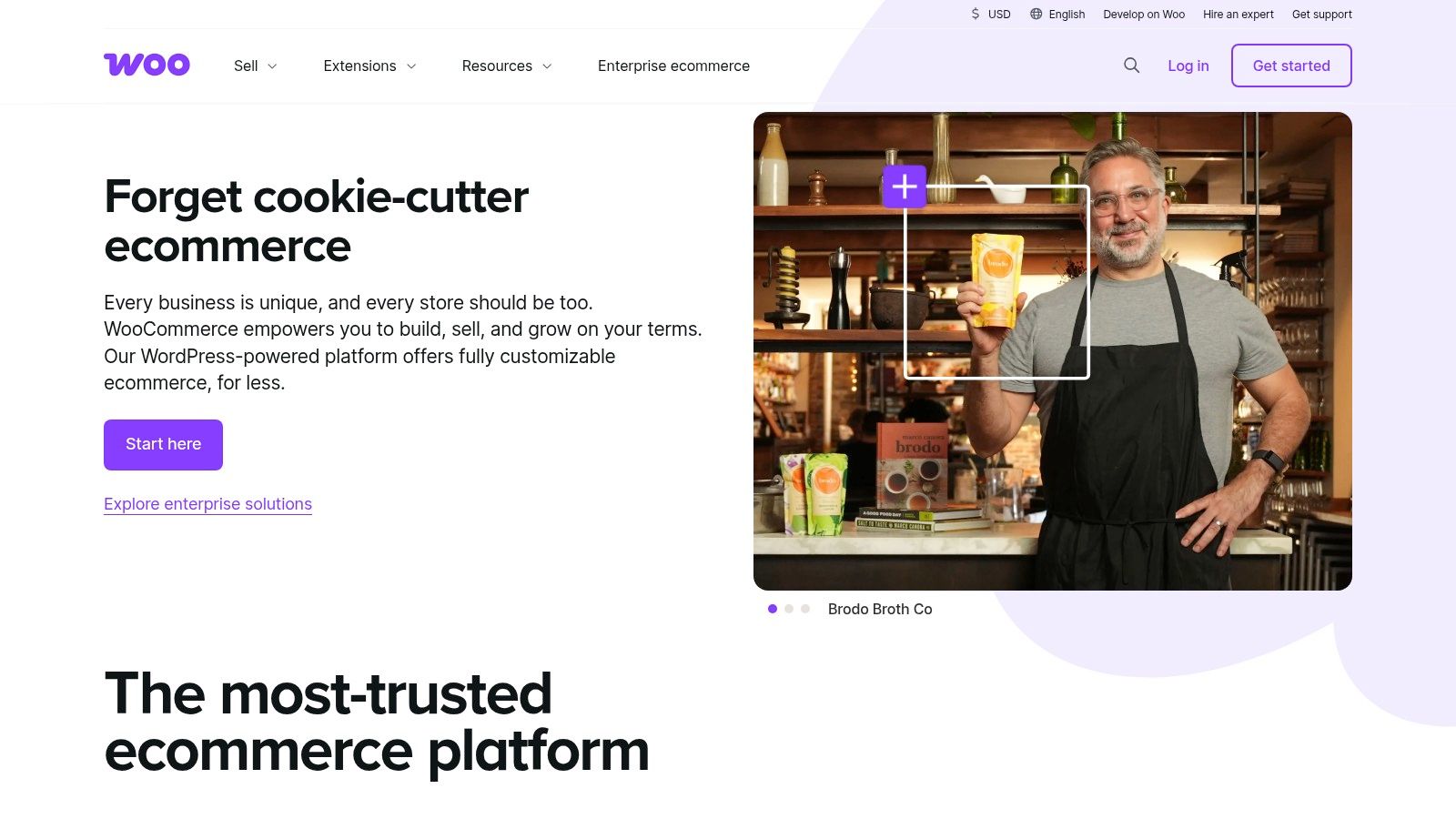
WooCommerce is not a standalone platform but a powerful, open-source ecommerce plugin built exclusively for WordPress. This transforms the world’s most popular content management system into a fully functional online store, offering an unparalleled blend of content and commerce. For creators and businesses already using WordPress, it presents one of the most integrated and flexible alternatives to Shopify.
Its core strength lies in its complete customisability and data ownership. Unlike a SaaS platform where you rent your store, WooCommerce gives you full control over every line of code and every piece of customer data, all within your existing WordPress environment.
Key Features & Capabilities
WooCommerce’s free core plugin is surprisingly robust, but its true power is unlocked through a vast ecosystem of extensions. You can tailor your store to almost any business model imaginable, from physical goods to exclusive digital content.
- Content & Commerce Integration: Seamlessly embed products into blog posts, create shoppable landing pages, and use WordPress’s powerful SEO capabilities to drive traffic to your store. This is ideal for content-first creators.
- Limitless Customisation: With thousands of themes and plugins available, you can build a unique user experience. You have complete control over the design and functionality, something often limited on other platforms.
- Extensive Payment Gateway Support: Beyond its native WooPayments solution, it integrates with hundreds of gateways, including strong support for European methods like SEPA, iDEAL, and Bancontact, ensuring you can accept payments from a global audience.
- Total Data Ownership: Your store data, customer information, and order history are all stored on your own hosting. You are not locked into a proprietary ecosystem.
Pricing Structure
The WooCommerce plugin itself is free, but you are responsible for the operational costs of running a WordPress site.
| Component | Cost | Best For |
|---|---|---|
| WooCommerce Plugin | Free | Everyone using WordPress for ecommerce. |
| Hosting, Domain & Security | Starts at €10-€30/month | Required for all self-hosted sites. Costs vary based on traffic and performance needs. |
| Premium Extensions | Varies (€0 - €250+ each) | Businesses needing advanced features like subscriptions, bookings, or memberships. |
The total cost is highly variable. A simple store may only incur hosting fees, while a complex one might spend hundreds on premium extensions and development.
Ideal Use Cases
WooCommerce is the definitive choice for entrepreneurs who are deeply invested in the WordPress ecosystem. A coach who runs a popular blog can effortlessly sell digital courses, e-books, and one-on-one sessions directly alongside their articles. It's also perfect for businesses that require highly specific functionalities not available out-of-the-box on Shopify, as there is likely a plugin for any conceivable need. Entrepreneurs looking to identify and serve unique audiences can explore different niches in the market with unparalleled flexibility.
Key Insight: Choose WooCommerce if you prioritise content marketing and want absolute, granular control over your store's design, functionality, and data. It's the ultimate "do-it-yourself" Shopify alternative for those who value freedom over convenience.
Pros & Cons
- Pros:
- The core software is 100% free and open-source.
- Unmatched customisation potential through themes and plugins.
- Full ownership of your store and customer data.
- Leverages the power and familiarity of the WordPress platform.
- Cons:
- Requires you to manage your own hosting, security, and updates.
- The learning curve can be steep for non-technical users.
- Costs can add up quickly with premium themes and extensions.
Discover more at WooCommerce.com
3. BigCommerce: The Scalable SaaS Contender
BigCommerce is a mature, all-in-one ecommerce platform designed for ambitious brands looking to scale without replatforming. It positions itself as an open SaaS solution, blending the ease of use of a hosted platform like Shopify with the flexibility often associated with open-source systems. This makes it a powerful choice for creators and businesses planning for rapid growth.
Its most compelling advantage is the elimination of platform transaction fees across all plans. Unlike Shopify, which charges a percentage on top of payment processor fees unless you use Shopify Payments, BigCommerce allows you to use your preferred payment gateway without penalty. This can lead to significant savings as your revenue grows.
Key Features & Capabilities
BigCommerce comes loaded with a comprehensive suite of native features, reducing reliance on third-party apps for core functionalities. This integrated approach helps maintain site speed and simplifies management.
- No Transaction Fees: Use leading payment gateways like Stripe or PayPal without incurring additional platform fees on any plan.
- Product & Catalogue Management: Supports unlimited products, file storage, and bandwidth. It handles complex product options and rules, making it ideal for merchandise with many variants.
- Omnichannel Sales: Built-in integrations allow you to sell directly on marketplaces like Amazon and eBay, as well as social media channels like Instagram and Facebook, all from a single dashboard.
- Internationalisation: Features multi-currency support, international payment gateways, and global CDN to provide a fast experience for customers worldwide. EU VAT and tax rules can be configured natively or enhanced via the app ecosystem.
Pricing Structure
BigCommerce's pricing is structured in tiers based on your annual online sales volume, offering a clear path for growth.
| Plan | Cost (USD) | Best For |
|---|---|---|
| Standard | $29/month | New businesses and creators starting their ecommerce journey. |
| Plus | $79/month | Growing brands needing customer segmentation and abandoned cart features. |
| Pro | $299/month | Established businesses requiring advanced features like Google customer reviews. |
A key detail is that you are automatically upgraded to the next plan when your sales exceed the threshold for your current tier. While this simplifies scaling, it's an important factor to consider in your financial planning.
Ideal Use Cases
BigCommerce is an excellent fit for serious creators and community owners who are building a brand with significant growth potential. A YouTuber with a fast-growing merchandise line would benefit from the platform’s ability to handle high order volumes and complex product catalogues without extra transaction fees. It is also a strong choice for businesses that plan to expand into both B2C and B2B sales channels.
Key Insight: BigCommerce is one of the strongest alternatives to Shopify for businesses that want to avoid platform transaction fees and require a robust, built-in feature set to support rapid scaling without needing to migrate platforms later on.
Pros & Cons
- Pros:
- Zero platform transaction fees on all plans.
- Comprehensive native feature set reduces the need for paid apps.
- Strong SEO capabilities and omnichannel integrations are built-in.
- 24/7 technical support is available on all plans.
- Cons:
- Automatic plan upgrades tied to sales revenue can lead to unexpected cost increases.
- The theme customisation interface is less intuitive than Shopify's section-based editor.
- Pricing is displayed in USD, and VAT/taxes are not included in the listed price.
Discover more at BigCommerce.com
4. Wix eCommerce: The AI-Powered Visual Store Builder
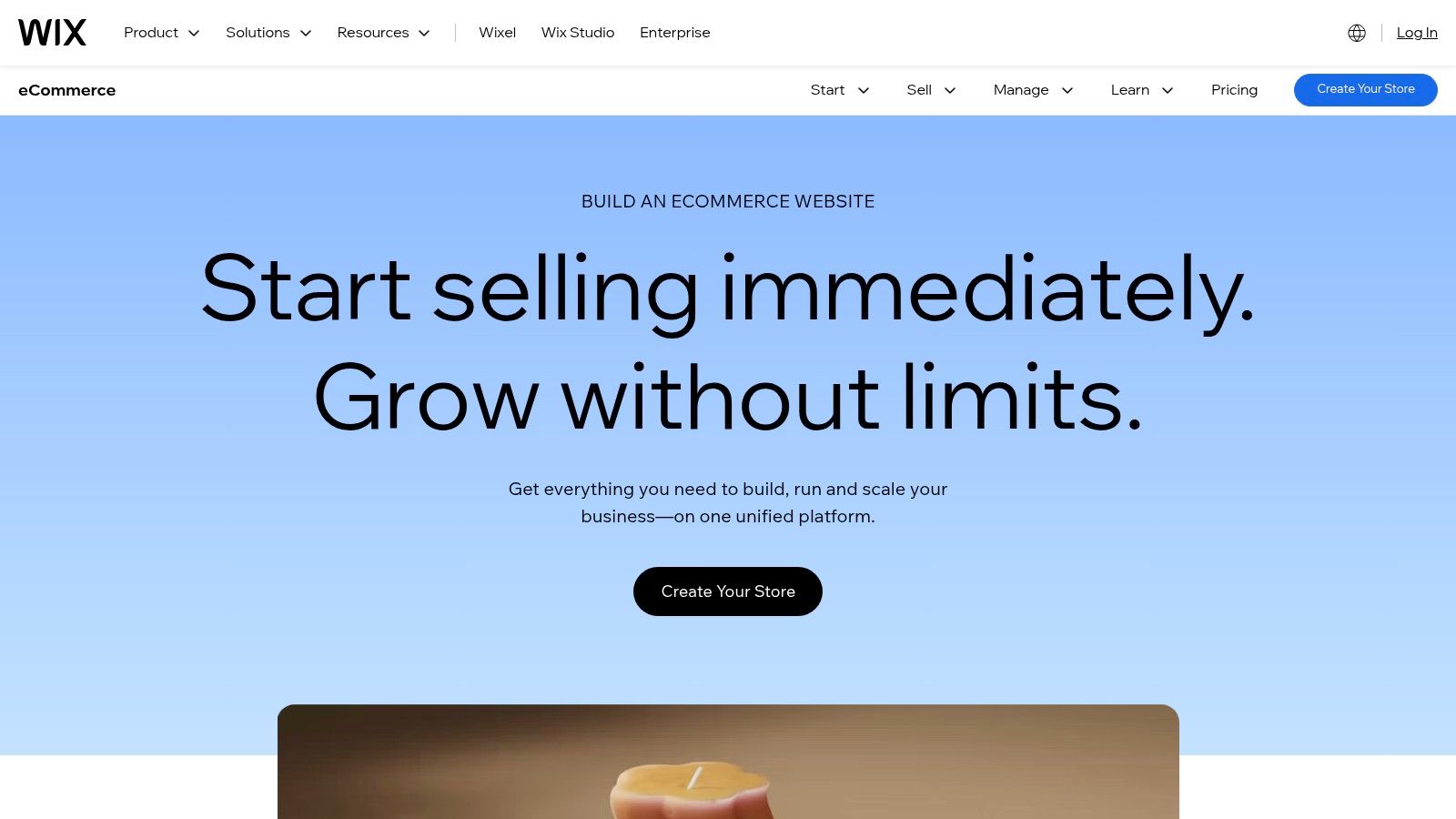
Wix eCommerce has evolved from a simple website builder into a comprehensive platform that prioritises ease of use and visual design. It leverages an intuitive drag-and-drop editor and AI-powered site creation tools, making it one of the fastest ways for creators and small businesses to launch a polished online store without touching a line of code.
This all-in-one approach combines hosting, security, and powerful ecommerce features into a single package. Its standout capability is its user-friendly interface, which significantly lowers the barrier to entry for merchants who value speed and aesthetic control over deep technical customisation.
Key Features & Capabilities
Wix provides an integrated ecosystem designed to get a store running quickly while offering tools for growth. The platform is particularly strong in its built-in marketing and localisation features, especially for the European market.
- Visual Site Builder: Choose between the classic drag-and-drop editor for total design freedom or the ADI (Artificial Design Intelligence) tool that builds a custom site for you based on a few questions. Over 70 professional store templates are available.
- Integrated Marketing Suite: Includes built-in tools for email marketing, social media posts, and customer management (CRM), allowing you to run campaigns directly from your dashboard.
- Wix Payments: A native payment gateway that simplifies transactions. It has favourable EU-specific rules, such as not charging cross-border fees for intra-EU sales, a clear advantage over some competitors.
- All-in-One Solution: Every ecommerce plan includes managed hosting, an SSL certificate, built-in analytics, and access to the Wix App Market for further extensibility.
Pricing Structure
Wix offers several tiered plans for ecommerce, with pricing often varying by region and currency. All plans are billed annually for the best value.
| Plan | Cost (Example) | Best For |
|---|---|---|
| Core | Starts around €20/month | Creators and small businesses starting with basic ecommerce and booking features. |
| Business | Starts around €30/month | Growing businesses needing more storage, developer tools, and advanced shipping. |
| Business Elite | Starts around €150/month | High-volume stores requiring priority support and maximum features. |
These plans provide a complete package, so there are no separate hosting or security costs to consider, making budgeting predictable.
Ideal Use Cases
Wix is an excellent fit for visually-driven brands, such as content creators selling merchandise, coaches offering digital products and appointments, or small businesses wanting a professional-looking storefront with minimal technical effort. A YouTuber launching a branded clothing line could use the AI builder to create a store in under an hour and manage sales and marketing from one central hub.
Key Insight: For merchants who prioritise speed-to-market and a visually stunning storefront over complex backend customisation, Wix is one of the most accessible alternatives to Shopify, removing nearly all technical barriers to entry.
Pros & Cons
- Pros:
- Extremely fast and easy to set up, even for absolute beginners.
- All-in-one platform includes hosting, SSL, and robust marketing tools.
- Full visual control with the drag-and-drop editor.
- EU-friendly payment processing with Wix Payments.
- Cons:
- Advanced ecommerce features may require more expensive plans.
- Significant vendor lock-in; it's difficult to migrate a complex Wix site to another platform.
- Less backend customisation compared to open-source solutions.
Discover more at Wix.com/ecommerce
5. Squarespace Commerce: The Design-First All-in-One
Squarespace Commerce is a visually driven website builder celebrated for its award-winning templates and all-in-one approach. It integrates ecommerce directly into its core platform, offering a seamless experience for creators and brands who prioritise aesthetics and simplicity. This makes it a strong contender for those seeking an elegant, unified online presence without the need for extensive technical skill.
Its primary strength lies in its polished, user-friendly interface. Where other platforms can feel overwhelming, Squarespace provides a curated and streamlined environment. It allows you to build a beautiful storefront, blog, and portfolio all under one roof, making it one of the most cohesive alternatives to Shopify for brand-centric businesses.

Key Features & Capabilities
Squarespace equips merchants with a solid set of native tools for selling a variety of products and services. The focus is on providing essential functionality within a beautifully designed package, covering everything from product sales to member areas.
- Diverse Product Support: Sell physical goods, digital downloads, services, subscriptions, and even gift cards. It’s an ideal platform for creators offering a mix of products, like an artist selling prints and online workshop access.
- Integrated Marketing Tools: Built-in email campaigns, social media integrations, and SEO features help you market your store directly from the Squarespace dashboard, creating a centralised command centre.
- Membership & Gated Content: The Member Areas feature allows you to monetise your community by selling access to exclusive content, courses, or newsletters, all without third-party plugins.
- Point of Sale (POS): The Squarespace POS app (powered by Square) lets you sell products in person at markets or pop-ups, with inventory automatically syncing with your online store.
Pricing Structure
Squarespace offers a straightforward, all-inclusive pricing model. All plans include hosting, a domain for the first year, and an SSL certificate. Commerce features are available on specific plans.
| Plan | Cost (Billed Annually) | Best For |
|---|---|---|
| Business | Starts at €21/month | Creators starting out, but has a 3% transaction fee on sales. |
| Commerce Basic | Starts at €28/month | Growing businesses needing 0% transaction fees and customer accounts. |
| Commerce Advanced | Starts at €48/month | Businesses requiring advanced features like subscriptions and abandoned cart recovery. |
Note that pricing and transaction fees can change, so it's always best to verify the current rates on their official site.
Ideal Use Cases
Squarespace excels for creators, artists, and service providers whose brand is built on a strong visual identity. A coach selling digital workbooks and one-on-one sessions, or a podcaster offering premium ad-free episodes via a member area, would find the platform's elegant design and integrated tools a perfect fit. It's built for those who value simplicity and aesthetics over granular customisation.
Key Insight: Choose Squarespace when your brand's visual presentation is as important as the products you sell. It removes technical barriers, allowing you to create a professional, high-end online store that looks stunning on any device with minimal effort.
Pros & Cons
- Pros:
- Best-in-class, mobile-responsive templates that are easy to customise.
- Truly all-in-one solution: hosting, security, and ecommerce in one package.
- Intuitive drag-and-drop editor and streamlined admin experience.
- Strong native features for selling digital products and memberships.
- Cons:
- Fewer payment gateway options compared to Shopify.
- Limited app ecosystem for extending functionality.
- Ecommerce features are less robust for very large or complex catalogues.
Discover more at Squarespace.com
6. Ecwid by Lightspeed: The Embeddable E-commerce Engine
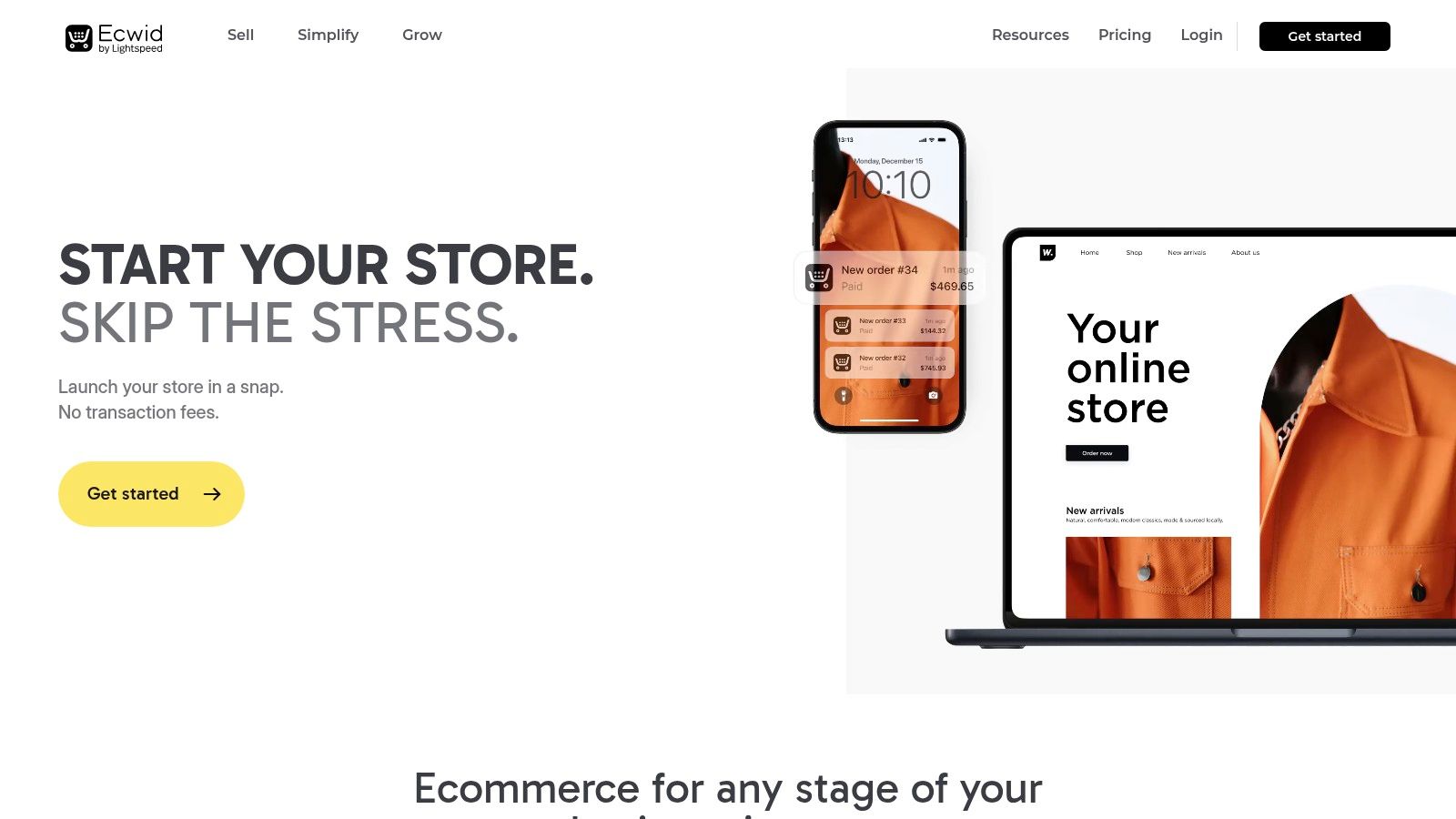
Ecwid by Lightspeed offers a unique and highly practical approach to e-commerce, functioning less as a standalone website builder and more as a powerful, embeddable storefront. It allows creators and businesses to add a full-featured online shop to any existing website, whether it's built on WordPress, Wix, Squarespace, or a custom-coded platform. This makes it an outstanding alternative to Shopify for anyone who loves their current website but wants to add sophisticated sales capabilities without a complete rebuild.
Its core proposition is simplicity and integration. Instead of migrating your content to a new platform, you bring the e-commerce to your content. For creators with an established blog or community site, this means you can start selling physical merchandise, digital downloads, or services in minutes, directly from the online home you've already built.
Key Features & Capabilities
Ecwid provides a surprisingly robust feature set that can be managed from a single dashboard, with changes automatically updating everywhere your store is embedded. This "sell anywhere" philosophy is its greatest strength.
- Embeddable Storefront: Generate a few lines of code to add your entire shop to any website or page. You can also sell simultaneously on social media platforms like Facebook and Instagram.
- Multi-channel Selling: Manage your inventory and sales across your website, social media, and online marketplaces like Amazon or eBay, all from one central Ecwid admin panel.
- Flexible Product Options: Supports physical goods, digital products, and services. It includes advanced features like product variations, automated tax calculations, and real-time shipping quotes.
- Payment & Compliance: Integrates with over 70 payment gateways, including Stripe and PayPal, and offers tools for VAT management and GDPR compliance, making it a reliable choice for European merchants.
Pricing Structure
Ecwid's pricing is designed to be accessible, with a functional free plan that makes it easy to start selling immediately. Its paid tiers add more advanced features and sales channels.
| Plan | Cost | Best For |
|---|---|---|
| Free | €0/month | Creators starting out, selling up to 5 physical products on an existing site. |
| Venture | €19/month | Growing businesses needing more products, social media selling, and an app market. |
| Business | €39/month | Serious sellers requiring marketplace integrations (Amazon, eBay) and advanced tools. |
| Unlimited | €99/month | High-volume merchants who need unlimited products and priority support. |
Importantly, Ecwid charges no platform transaction fees on any of its plans, which can lead to significant savings compared to other platforms.
Ideal Use Cases
Ecwid is the perfect solution for a content creator or community owner who already has a thriving WordPress blog or a portfolio site on Squarespace. Imagine a coach who wants to sell digital workbooks and branded merchandise directly from their existing blog posts without disrupting their site's structure. Ecwid allows them to embed product listings right where their audience is already engaged. It’s also ideal for those wanting to test an e-commerce idea with minimal initial investment, thanks to its capable free plan.
Key Insight: If you already have a website you love, Ecwid is one of the fastest and most cost-effective alternatives to Shopify for adding a powerful, multi-channel e-commerce layer without starting from scratch.
Pros & Cons
- Pros:
- Seamlessly adds e-commerce to any existing website.
- Generous free plan available to start selling immediately.
- No platform transaction fees on any plan.
- Manage sales across multiple channels from a single dashboard.
- Cons:
- Less suitable for building a complete, content-heavy website from the ground up.
- Advanced customisation and features are locked behind higher-tier plans.
- Relies on the design and SEO of your existing site, offering fewer built-in tools.
Discover more at Ecwid.com
7. Shopware: The Enterprise-Ready German Powerhouse
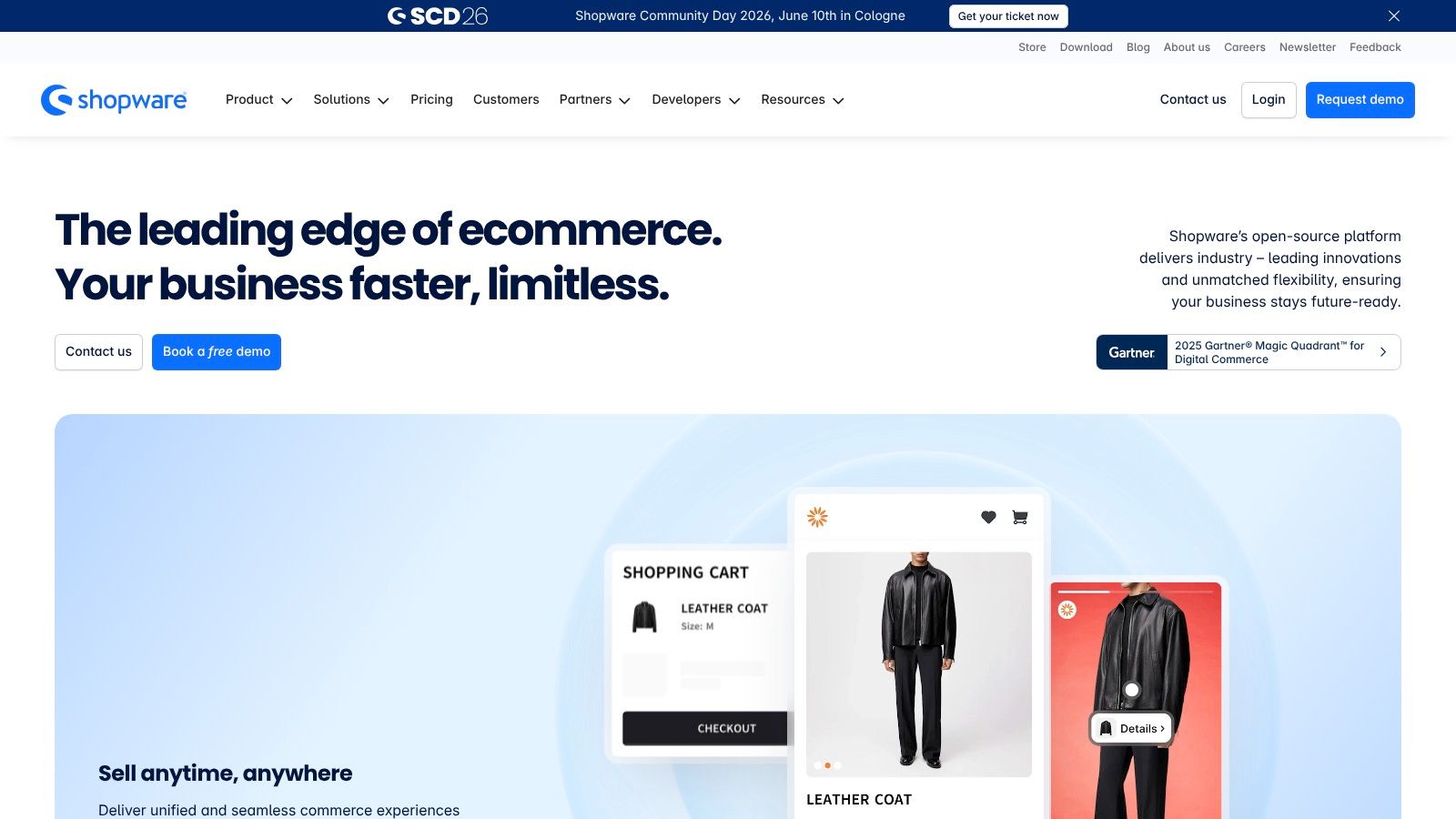
Shopware is a sophisticated, API-first ecommerce platform with deep roots in Germany and a commanding presence in the DACH/European market. It presents a dual-deployment model similar to PrestaShop, offering flexible self-managed versions alongside a powerful, tiered cloud (SaaS) solution. This makes it an excellent alternative to Shopify for established businesses and creators aiming for serious scale, especially within the EU.
Its core strength lies in its enterprise-grade architecture, designed for complex catalogues, B2B sales, and advanced merchandising from the ground up. Where Shopify often relies on a web of apps to handle complex B2B logic or rich content experiences, Shopware builds these powerful capabilities directly into its platform, particularly in its higher-tier plans.
Key Features & Capabilities
Shopware is engineered for flexibility and complexity, providing tools that cater to both B2C and B2B operations. Its API-first nature means it's built to integrate seamlessly with other business systems like ERPs and CRMs.
- Deployment Options: Choose between the free, self-hosted Community Edition for maximum control or opt for a managed SaaS cloud plan (Rise, Evolve, Beyond) for a turnkey solution.
- Advanced B2B Suite: Higher tiers offer powerful features like customer-specific pricing, budget management, quoting tools, and digital sales rooms for corporate clients.
- Powerful Merchandising: Includes advanced tools for creating dynamic product groups, AI-powered features, 3D product visualisations, and integrated multi-channel sales capabilities.
- API-First Architecture: The platform is built around a robust API, making it highly extensible and ideal for headless commerce projects and complex, custom integrations.
Pricing Structure
Shopware offers transparent, EUR-based pricing for its cloud solutions and a free open-source option, completely free from revenue-sharing fees.
| Plan | Cost | Best For |
|---|---|---|
| Community Edition | Free (software only) | Developers and businesses with the technical resources for self-hosting. |
| Shopware Rise | Starts at €600/month | Growing businesses needing a comprehensive, managed SaaS solution. |
| Evolve & Beyond | Custom Pricing | Large-scale enterprises requiring advanced B2B features and dedicated support. |
The free version requires sourcing your own hosting and performing manual updates. The cloud plans provide a fully managed environment, with entry-level pricing reflecting its more enterprise-focused positioning.
Ideal Use Cases
Shopware excels for mid-market to enterprise-level businesses, particularly those operating in the EU with complex B2B and B2C sales models. A creator who has scaled their merchandise brand and is now looking to launch a wholesale program for European retailers would find its B2B suite invaluable. It's a top-tier choice for businesses that have outgrown simpler platforms and need a scalable, API-driven foundation.
Key Insight: For businesses targeting the European market with complex catalogues or a B2B sales channel, Shopware provides an enterprise-level infrastructure without forcing you into a costly, monolithic suite. It stands as one of the most powerful alternatives to Shopify for ambitious scaling.
Pros & Cons
- Pros:
- Enterprise-ready for complex EU-centric catalogues and B2B workflows.
- Transparent EUR-based cloud pricing with no revenue share.
- Highly flexible with both self-managed and powerful SaaS options.
- Strong developer community and extensive partner ecosystem.
- Cons:
- Higher entry price for cloud tiers compared to SMB-focused builders.
- Implementation and customisation often require a development partner or professional services.
- The learning curve is steeper than Shopify's, reflecting its advanced capabilities.
Discover more at Shopware.com
Shopify Alternatives: 7-Platform Comparison
| Platform | 🔄 Implementation Complexity | ⚡ Resource Requirements | ⭐ Expected Outcomes / 📊 Impact | 💡 Ideal Use Cases | 📊 Key Advantages |
|---|---|---|---|---|---|
| PrestaShop | Medium–High — Classic: self-hosted (manage hosting/updates); Hosted: lower complexity | Varies — dev/hosting for Classic; moderate subscription for Hosted | Strong EU compliance and customization; suitable for regulated markets | EU/France merchants needing data ownership and built-in GDPR/VAT tools | EU localization, large module marketplace, open-source flexibility |
| WooCommerce | Medium — requires WordPress setup and ongoing plugin management | Low base cost (free core); resources for hosting, extensions, maintenance | Flexible content+commerce integration; scalable if actively maintained | Content-driven stores and WordPress users seeking ownership | Free core, huge ecosystem, no platform transaction fees |
| BigCommerce | Low–Medium — SaaS with rich native features; less technical overhead | Subscription pricing; scales without platform transaction fees; minimal ops | Enterprise-ready platform enabling fast scaling and omnichannel sales | Fast-growing B2C/B2B brands needing built-in capabilities | Feature-rich out of the box, 24/7 support, no platform fees |
| Wix eCommerce | Low — drag-and-drop + AI builder; minimal setup and learning curve | All-in-one subscription (hosting/SSL/templates included); fast launch | Polished, quick-to-market storefronts; limited for complex catalogs | Small businesses wanting visually strong, fast launches | Fastest time-to-launch, integrated marketing and payments |
| Squarespace Commerce | Low — streamlined builder with simple commerce flow | Subscription includes hosting/security; limited deep customization | High-quality design and streamlined checkout for simple catalogs | Design-forward brands prioritizing aesthetics and simplicity | Best-in-class templates, simple admin and integrated tools |
| Ecwid by Lightspeed | Low — embeddable storefront or instant site; very quick setup | Minimal resources; free tier available; transparent regional pricing | Adds ecommerce quickly to existing sites; limited deep customization | Add commerce to existing websites without a rebuild | Embeddable multi-site selling, free plan, clear pricing |
| Shopware | High — enterprise implementations typically require partners/services | Higher cloud entry pricing or significant dev resources for self-hosted | API-first platform with strong B2B features and merchandising for EU scale | Enterprise/mid-market EU brands with complex catalogs/workflows | Enterprise-grade, EUR-quoted tiers, robust partner ecosystem |
Choosing the Right Path for Your Business
Navigating the landscape of e-commerce platforms can feel overwhelming, but as we've explored, the world beyond Shopify is rich with powerful, specialised solutions. Your search for alternatives to Shopify isn't just about finding a different checkout page; it's about discovering an ecosystem that aligns perfectly with your unique business model, technical comfort level, and long-term vision. The "best" platform is not a one-size-fits-all answer but a strategic choice tailored to your specific needs.
The journey through platforms like WooCommerce, BigCommerce, and PrestaShop has shown that a single-minded focus on traditional e-commerce is just one piece of the puzzle. Each of these contenders offers distinct advantages. If you are already invested in the WordPress ecosystem, WooCommerce presents an almost seamless extension of your existing setup, offering unparalleled customisation. For businesses anticipating rapid scaling and needing robust, enterprise-level features without the associated complexities, BigCommerce stands out as a formidable, performance-oriented choice. Meanwhile, for merchants in Europe, particularly in France, PrestaShop and Shopware offer deep localisation and regulatory compliance that are difficult to match.
Making a Strategic Decision: A Final Checklist
Making the final call requires a clear-headed evaluation of your core priorities. Don't be swayed by features you don't need or marketing hype that doesn't apply to your business. Instead, use this checklist to guide your decision-making process and select the platform that will truly catalyse your growth.
- Core Business Model: Are you primarily selling physical products, digital downloads, memberships, or a blend of all three? Platforms like Wix and Squarespace excel at visual-heavy product catalogues, whereas a community-focused tool is better suited for monetising access and content.
- Technical Expertise: Be honest about your comfort with technology. WooCommerce and Shopware offer immense flexibility but require a more hands-on approach. In contrast, all-in-one builders like Squarespace and Wix prioritise ease of use, allowing you to launch quickly with minimal technical knowledge.
- Scalability and Growth: Where do you see your business in five years? Consider transaction fees, plan limitations, and the ability to expand internationally. BigCommerce, for instance, is renowned for its zero transaction fees on all plans, making it a cost-effective option as your sales volume increases.
- Budget and Total Cost of Ownership: Look beyond the monthly subscription fee. Factor in the costs of essential apps, themes, payment gateway fees, and potential developer support. An open-source solution like PrestaShop might appear free initially, but the total cost of ownership can grow with customisation and maintenance.
- Community vs. Commerce: This is the most crucial consideration for modern creators. Is your primary goal to manage inventory and ship products, or is it to build, engage, and monetise a dedicated community? A traditional e-commerce platform is built for the former, but a specialised community monetisation tool is engineered for the latter.
The Path Forward: From Choice to Action
Ultimately, moving away from a platform like Shopify is a declaration of your business's unique identity. It’s a recognition that your needs have evolved beyond a generic e-commerce framework. Whether you're a crypto trading group needing to manage exclusive access, a coach selling high-value programmes, or a creator monetising a giveaway community, your platform should be an enabler, not a bottleneck.
The right choice will feel less like a compromise and more like a liberation, empowering you to connect with your audience, deliver value, and build a sustainable, profitable enterprise on your own terms. Trust your assessment, choose the tool that amplifies your strengths, and step confidently into the next chapter of your business's growth.
If your business is built around a community on platforms like Telegram or Discord, managing payments and access shouldn't be a complex, manual task. Join My Thread offers a direct, automated solution specifically designed for creators and community owners, making it one of the most efficient alternatives to Shopify for this use case. Automate your member subscriptions and focus on what you do best: building your community by visiting Join My Thread to get started.