
Community Monetization Models for Creators
Published on November 23, 2025 · Reading time: 18 min
Community monetization is all about generating revenue directly from your members. It’s a simple trade: you provide exclusive value—like premium content, special access, or deeper connections—and they support the community financially. This isn't just about making money; it's about turning a casual audience into a committed group of backers who want to see your project thrive.
What Is Community Monetization Really?
At its heart, community monetization marks a huge shift in how creators build sustainable careers. Forget the old-school model of chasing massive, passive audiences just to sell ads. This new way of thinking is all about creating a high-value, exclusive space where your most dedicated members are more than happy to pay for a premium experience.
Think of it like the difference between a free public park and a private country club. The park is open to everyone, offering general access and broad appeal. The country club, on the other hand, provides exclusive amenities for a fee—a pristine golf course, private events, and a close-knit social circle. Members don't just pay for access; they pay for the quality, exclusivity, and shared identity that comes with it. Community monetization brings that very same principle into your digital world.
The Shift from Audience to Community
This move from a free-for-all group to a structured, paid community is happening for two big reasons. First, creators are looking for reliable income streams they actually control, getting away from the rollercoaster of ad revenue and unpredictable platform algorithms. Second, people are craving genuine connection and are willing to pay for spaces that are free from noise and distractions.
The goal isn't just to put up a paywall. It's about making the value exchange that's already happening official. Your most engaged members are already getting tons of value from your content and the connections they make. Monetization simply formalises that relationship and makes it sustainable for the long haul.
This shift is fuelling some serious economic growth. Take France's creator economy, for instance. It's seeing incredible expansion driven by these exact strategies, with its market value projected to hit USD 36,662.45 million by 2032. This shows a powerful move towards smarter revenue models that go way beyond traditional advertising. You can explore more about the growth of the creator economy and see its impact for yourself.
Key Differences to Understand
Now, building a monetized community calls for a completely different mindset than just growing an audience. An audience consumes content; a community participates in it. Getting this distinction right is everything.
To make it crystal clear, let's break down the differences.
Audience Growth vs Community Monetization At a Glance
| Aspect | Traditional Audience Growth | Community Monetization Focus |
|---|---|---|
| Primary Goal | Maximise reach and follower count. | Cultivate deep engagement and member value. |
| Key Metric | Views, impressions, and follower numbers. | Member retention, churn rate, and lifetime value (LTV). |
| Member Role | Passive consumers of content. | Active participants and co-creators. |
| Value Proposition | Free, accessible information for everyone. | Exclusive content, access, and connections for members. |
Ultimately, the table shows two different paths. Audience growth is a numbers game focused on scale, while community monetization is a value game focused on depth and sustainability. One isn't necessarily better than the other, but knowing which game you're playing is crucial for success.
Alright, let's talk about turning your community into a sustainable project. Choosing how to make money from your group isn't just about picking a price tag; it's about defining the entire relationship you have with your members. Think of it as the business plan for your exclusive club.
Each approach creates a different vibe and sets different expectations. Your choice will shape how members engage, what they value, and whether your community thrives for the long haul. It’s a strategic decision that needs to align with the unique culture you've built.
This simple decision tree can help you figure out if you're still in the audience-building phase or if you're ready to jump into a dedicated monetization strategy.
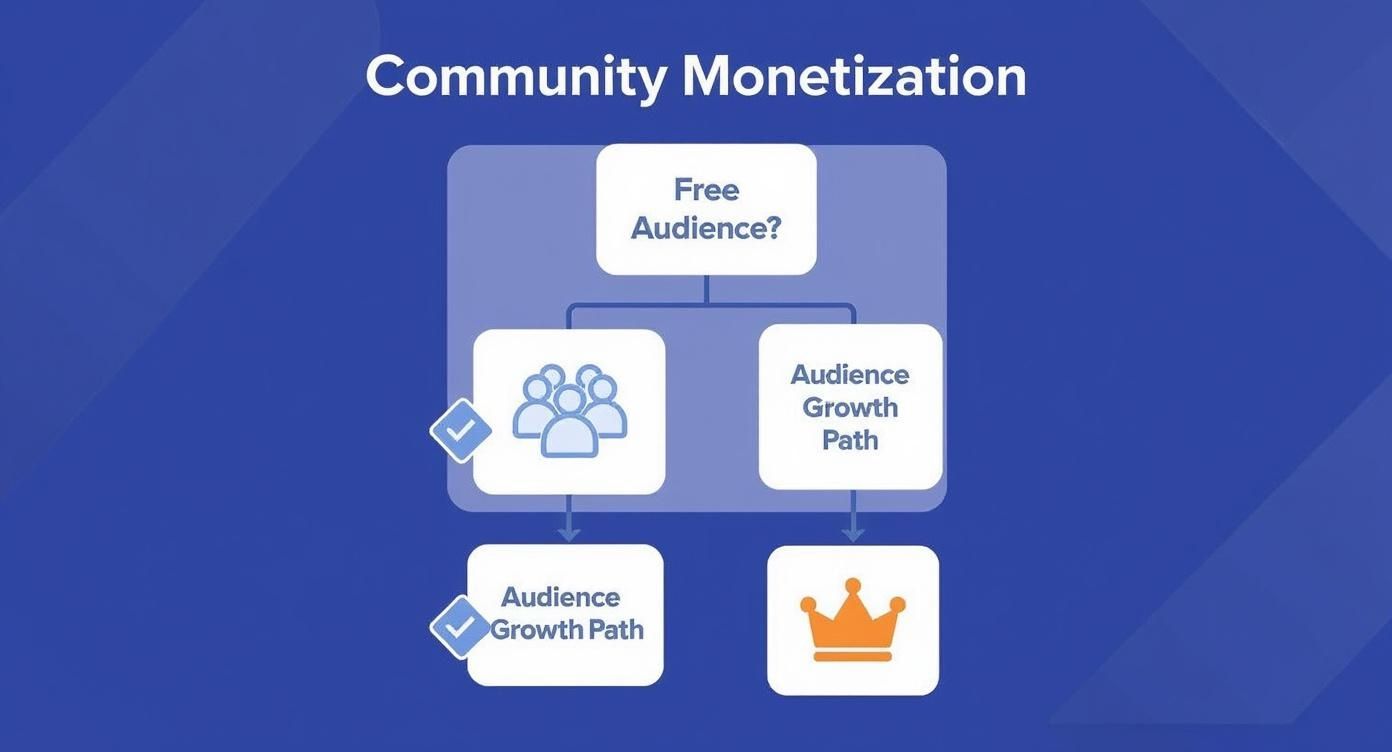
The main point here? Monetization isn't an afterthought. It's an intentional path you commit to, completely different from just gathering a free-for-all audience.
The Subscription Model: Your Recurring Revenue Engine
Think of this as the "Netflix" model for your community. Members pay a recurring fee—usually monthly or yearly—for ongoing access to your group, content, and all the exclusive perks you offer. It's the most popular way to monetise a community for a very good reason.
Subscriptions create a predictable, stable revenue stream. That stability is gold when you're trying to plan for growth and invest back into the community. For members, it means uninterrupted value and a real sense of belonging. This model is a perfect fit for groups that deliver continuous value, like coaching circles, masterminds, or any community with daily discussions and fresh content.
One-Time Fees for Lifetime or Timed Access
This is like selling a ticket to a specific event. A member pays once for access to a particular offering—maybe a multi-week workshop, a 30-day challenge, or lifetime access to a library of resources. It's a fantastic approach for high-value, time-bound experiences.
The lower commitment can make it an easier "yes" for new members. The downside? Your revenue is far less predictable, as you constantly need to be launching new things to keep the income flowing. This is a go-to for course creators or communities built around a specific programme or event.
Selling Digital Products and Resources
Here, you're running an "à la carte" menu. Instead of charging for entry to the group itself, you sell valuable digital goodies directly to your members. This could be anything from ebooks and templates to in-depth guides or pre-recorded courses.
This model lets you monetise your expertise without putting the community behind a gate, which helps keep the group open and growing. The challenge, however, is that revenue can be lumpy. It all depends on your ability to consistently create and market new products that your members genuinely want to buy.
Donations and Member Patronage
The "patronage" model runs on the goodwill of your most dedicated supporters. You keep the community free and open but provide a way for members to contribute financially if they're getting a lot of value from the space. Think of it as a virtual tip jar, often managed through platforms built for creator patronage.
This approach is best suited for communities built around a shared cause, a powerful personal brand, or a mission that people want to get behind. It keeps access wide open but makes monetisation completely optional, which means your income can be highly unpredictable.
Partnerships and Brand Sponsorships
Finally, we have the "endorsement" model. This is all about teaming up with brands that want to connect with your audience. It can take many forms: sponsored content, affiliate marketing links, or a brand sponsoring a specific workshop within your group. This strategy lets you keep the community free for members while generating revenue from outside partners.
The absolute key is making sure any partnership is a natural, authentic fit for your community's interests. A poorly aligned sponsor can feel jarring and erode the trust you've worked so hard to build. This is an especially powerful strategy in the evolving French creator economy, where creators are diversifying well beyond simple ads. With social media platforms holding 47.9% of the market share in 2024, they are the main playground for these collaborations, often driven by the 71.5% of amateur creators now dominating the space. You can discover more insights about the French creator economy here.
To help you decide, let's break down the most common revenue models side-by-side.
Comparison of Community Revenue Models
| Model | Revenue Predictability | Best For | Key Challenge |
|---|---|---|---|
| Subscriptions | High | Ongoing value communities (coaching, masterminds, expert groups) | Consistently delivering value to prevent member churn |
| One-Time Fees | Low | Time-bound offerings (workshops, courses, challenges) | Constant need to launch new products to generate income |
| Digital Products | Medium | Communities where expertise can be packaged (templates, guides) | Creating products members want and marketing them effectively |
| Donations | Very Low | Mission-driven or cause-based communities | Unpredictable revenue; relies entirely on member goodwill |
| Sponsorships | Medium | Niche communities with a clear, valuable audience | Finding authentic brand partners that don't alienate members |
Ultimately, choosing the right path forward means weighing these options against your community's core purpose and your own capacity as its leader.
Implementing Your Monetization Strategy

Picking a model is the first big decision. But turning that idea into a real, revenue-generating community? That takes a clear, step-by-step plan. This is where the theory gets real.
Launching a paid community isn't like flipping a switch. It’s about methodically building a professional and seamless experience that feels worth the price from day one. Every detail matters, from defining what members are actually paying for to making sure their first interaction is smooth and welcoming.
Let's walk through the actionable blueprint for bringing your paid community to life.
Define Your Value Proposition
Before you can even think about a price, you need to be crystal clear on what you're selling. Your value proposition is the promise you make to every single paying member. It’s the answer to their core question: "Why is this worth my money?"
A fuzzy value proposition leads to confusion and, inevitably, high churn. Forget vague promises like "exclusive access." You need to get specific. Are they paying for weekly Q&A sessions with you? A library of unique templates? Maybe it's priority access to your insights before anyone else gets them.
The key is to package your value into tangible benefits. Think of it as creating a menu for your community. Members should know exactly what they are ordering and why it’s so valuable to them.
For instance, a trading community’s value might be daily market analysis and real-time trade alerts. For a coaching group, it could be bi-weekly group calls and a private resource hub. Whatever it is, write it down. Make it the centrepiece of all your marketing.
Set Your Pricing Tiers
Once your value is clear, you can tackle pricing. This step often intimidates creators, but it doesn't have to be a shot in the dark. The goal is to find that sweet spot that reflects the incredible value you provide without pricing out your ideal members.
Start by having a look at similar communities in your niche. What are they charging, and what do they offer for that price? This gives you a baseline. But don't just copy them. Your price should be a confident statement about the unique results or experiences you deliver.
Consider offering a few simple pricing tiers to get started:
- Monthly Subscription: The classic choice. It offers a lower initial commitment for members and gives you predictable, recurring revenue.
- Annual Subscription: A great way to boost cash flow and lock in members. Offer a discount (like "two months free") for the yearly commitment.
- Lifetime Access: A high-ticket, one-time payment for permanent access. This can be fantastic for initial funding, but you sacrifice the recurring revenue.
The golden rule? Keep it simple. One or two clear options are almost always more effective than five confusing ones.
Automate the Onboarding Process
The moment a member pays is the most critical point in their entire journey with you. A clunky, manual onboarding process creates a terrible first impression and saddles you with a huge administrative headache. Automation is your absolute best friend here.
A seamless onboarding flow should look something like this:
- Payment: The member signs up on a clean, simple payment page.
- Instant Access: Immediately after payment, they get an automated welcome email with a direct link to join the WhatsApp or Discord community.
- Welcome Message: Once they're in, an automated message or post greets them and tells them what to do next.
This whole process should happen in minutes, without you lifting a finger. This is exactly the problem platforms like Join My Thread are built to solve. They connect your payment gateway (like Stripe) directly to your community, automating invitations and guaranteeing new members get instant, hassle-free access.
For Discord communities, a well-organised server is a massive part of this welcome. You can learn more about how to build a professional Discord server in our detailed guide.
Choose Your Payment Tools
To actually accept payments, you'll need a reliable payment processor. While there are tons of options, most creators stick to a few trusted names.
| Payment Tool | Best For | Key Consideration |
|---|---|---|
| Stripe | Subscriptions & global payments | The industry standard for a reason. It's incredibly flexible, developer-friendly, and perfect for subscription businesses. |
| PayPal | Simple, one-time payments | Widely trusted by consumers but can have higher fees and more restrictive policies for certain types of businesses. |
Often, the best solution is a platform that integrates directly with these processors. Tools built specifically for community monetisation handle all the technical heavy lifting, so you just connect your Stripe account and you’re good to go. This approach removes the complexity of managing payments all on your own.
Manage Member Retention and Churn
Getting a new member is only half the battle. Keeping them is what builds a sustainable business. Member churn —the rate at which members cancel their subscriptions—is a vital sign for your community's health. High churn is a massive red flag that your value isn't hitting the mark.
Managing churn effectively requires a proactive strategy, not a reactive one:
- Engage Consistently: Keep delivering on your promise. If you promised weekly content, deliver it. Every single week.
- Check In: Don't be afraid to survey your members. Ask them what they love and what could be better.
- Automate Dunning: Use a system to automatically handle failed payments. A good platform will notify members of payment issues and retry the charge before cancelling their access, recovering revenue you would have otherwise lost.
Handle Legal and Privacy Essentials
Last but not least, don't overlook the legal stuff. You don't need to be a lawyer, but having basic protections in place is professional and, frankly, essential.
Two key documents you’ll want to have are:
- Terms of Service: This outlines the rules of your community, payment terms, refunds, and what members can expect from you.
- Privacy Policy: This explains how you collect, use, and protect member data. This is a legal requirement in many parts of the world.
You can find plenty of templates online to get started. The most important thing is to be transparent with your members about the rules and how their data is handled. This builds trust and sets clear expectations for everyone right from the start.
Building a Thriving Paid Community
Getting your paid community off the ground is a massive achievement, but it's really just the first step. The real work—and where you build something that lasts—is turning that launch into a buzzing, self-sustaining hub. This is where good community management meets the practical science of keeping members around.
Too many creators pour all their energy into the setup and forget about the long game. A paid community isn't a one-off sale; it's a commitment to consistently give your members more than they expect. The goal is to create an experience so essential they couldn’t imagine leaving.
This isn't just about collecting payments. It's about nurturing a culture where every member feels seen, heard, and genuinely connected.
Foster a Culture of Genuine Value
At its heart, a thriving paid community has one simple rule: members must feel they get more value than what they pay for. This goes way beyond just content—it’s about the entire experience. Value can pop up in all sorts of ways, from exclusive insights to the powerful connections members forge with each other.
To make this happen, you have to deliver on your promise, day in and day out. If you sold access based on weekly Q&As, those sessions better be on time and packed with gold. If the draw was a supportive network, then you need to be in there, actively making introductions and sparking conversations.
Your paid community should be the single best place for a member to achieve a specific outcome or connect with like-minded peers. When that’s true, the subscription fee becomes a no-brainer.
Think about the unique rituals you can build. One community leader running a group for freelance writers noticed engagement was starting to sag. She started a "Member Spotlight" every Friday to celebrate a member's recent success. This simple act didn't just boost engagement; it actually doubled her member retention in three months because it made people feel recognised and part of something special.
Create Exclusive Member Rituals
Rituals are what make a community feel alive. They're the recurring events and shared moments that create a true sense of belonging and set your paid group apart from any free alternative.
They don’t need to be complex, either. Try mixing a few scheduled and spontaneous activities:
- Weekly Wins: A dedicated thread for members to share their progress.
- Monthly Expert AMAs: Bring in an expert (or step up as the expert yourself) for an exclusive "Ask Me Anything" session.
- Quarterly Challenges: Organise a group challenge that gets everyone working towards a common goal, reinforcing the community’s core purpose.
These activities create a natural rhythm and give members clear reasons to check in and participate regularly. It's this steady engagement that turns quiet subscribers into your community's biggest fans.
Evolve with Member Feedback
Your community is a living thing; it has to adapt to stay healthy. The best compass you have for guiding its evolution is listening—really listening—to your members. Their feedback is pure gold for improving your community and stopping people from leaving.
Create simple, direct ways for them to share their thoughts, like anonymous surveys or a dedicated feedback channel. Ask them what’s working, what’s missing, and what they wish they had more of. When you act on that feedback, it sends a powerful message: you value them for more than just their subscription fee.
This need for constant evolution is mirrored across the creator world. In France, for example, we can see how the perception of value directly impacts earnings. Top creators in education and lifestyle niches can pull in USD 1.50–USD 2.00 per 1,000 views, a clear sign that audiences are willing to reward valuable content. You can discover more insights about French creator earnings here.
Tracking Metrics That Actually Matter

Once your paid community is up and running, it’s far too easy to get lost in a sea of data. Follower counts and post likes feel good, sure, but they’re vanity metrics. They don't tell you a thing about the actual financial health of your community.
To make smart decisions, you have to focus on the numbers that truly drive the business.
Think of these key performance indicators (KPIs) as the dashboard for your community. Each one is a clear signal that helps you understand what’s working, what isn’t, and where to put your energy next. Let’s break down the metrics that will actually guide your success.
Financial Health and Sustainability Metrics
These are the numbers that tell you if your model is sustainable and reveal the long-term value you're creating. They’re the financial heartbeat of your community:
- Monthly Recurring Revenue (MRR): This is the single most important number for any subscription-based community. MRR shows you the total predictable revenue you can expect every single month, giving you a clear picture of your stability and growth. It's your North Star.
- Customer Lifetime Value (CLV): CLV answers a critical question: what’s a member worth over the entire time they stay with you? A high CLV is a powerful sign of a healthy community because it means your members are sticking around and finding real, long-term value.
- Churn Rate: This is the percentage of members who cancel their subscription each month. Churn is your primary indicator of member satisfaction. If it’s high, it’s a massive warning sign that your value proposition isn't hitting the mark or that engagement is dropping off.
Engagement and Growth Metrics
Beyond the financials, you need to know how well you're attracting new members and, crucially, keeping them engaged. These metrics measure the effectiveness of your content and your marketing.
Tracking engagement isn't just about counting clicks; it's proof that your paid content is hitting the mark. When members actively participate, it validates their decision to subscribe and makes them far more likely to stay.
Here are the two key growth indicators you need to watch:
- Engagement Rate: This measures how actively your members are participating. Are they commenting, reacting, or posting? You can track this by looking at the percentage of members who take an action within a given period. Low engagement is almost always a leading indicator of future churn.
- Conversion Rate: This metric shows you how effectively you turn interested prospects into paying members. Simply divide the number of new subscribers by the total number of visitors to your sign-up page. A low conversion rate might signal problems with your pricing, your sales page, or the way you're communicating your value.
By consistently keeping an eye on these five core metrics, you move beyond guesswork. You gain the insights needed to make informed decisions, improve your offerings, and build a truly sustainable, profitable community.
Common Questions About Community Monetization
Taking the leap into community monetization is a big step. It’s exciting, but it’s also normal to have a head full of questions and what-ifs. Getting clear, straightforward answers is what turns uncertainty into a confident launch plan.
This final section cuts through the noise. We're tackling the most common questions creators have when they decide to build a paid community, with practical advice to help you navigate your launch and grow for the long haul.
How Big Does My Community Need to Be Before I Charge?
This is usually the first question on everyone's mind, and the answer might surprise you. There is no magic number. Forget follower counts. The real metric is the quality of engagement and the value you provide.
A small, buzzing community of 50 true fans getting immense value is far more sustainable (and profitable) than a ghost town of 5,000 silent members. The right time to launch a paid offer is when you have a core group that consistently shows up, asks questions, and makes it clear they rely on what you provide.
Look for these signs instead of chasing big numbers:
- Consistent Engagement: Are people actually talking? Do they comment, participate, and react?
- Direct Feedback: Are members telling you—unprompted—how much your advice has helped them?
- A Core Group of Fans: Can you name a handful of "superfans" who are always there?
If you can nod your head to these points, you’re probably ready. The size of the group doesn't matter as much as the strength of its core.
What Content Justifies a Paid Subscription?
People won't pay for what they can Google for free. Your paid offering has to be a clear, undeniable upgrade in value, exclusivity, and access. It’s about creating a premium experience that solves a real problem for your members.
Think of it as the difference between a public library and a private, curated collection with an expert guide—you.
The core principle is simple: pay for access, stay for the value. Members might sign up for the exclusive content, but they'll remain subscribed because of the community, the results they achieve, and the ongoing support they receive.
Here’s what that looks like in practice:
- Deeper Access to You: Weekly live Q&A sessions, personalised feedback, or priority direct messaging.
- Exclusive, Actionable Content: Detailed workshops, step-by-step templates, or in-depth resources you don’t share with your free audience.
- A Curated and Vetted Network: A room full of serious, like-minded individuals, away from the noise of public forums.
- Tangible Results: If your community helps members hit a specific goal—like landing a client or learning a new skill—that outcome itself is the ultimate justification.
How Do I Move Members from a Free to a Paid Model?
Transitioning an existing free community can feel awkward, but with a transparent and thoughtful plan, it's entirely manageable. The key is to make your members feel like they're being invited into an exciting new chapter, not just hit with a surprise bill.
Start by communicating the change well in advance. Explain why you're making the shift—to dedicate more time, create better resources, and build a more focused space for your most committed members. Clarify that the free group might stick around in a limited form, but the real action will now be inside the paid community.
Then, offer your most engaged members an exclusive "founder's rate." This is a special, lifetime discount as a thank you for their early support. It rewards their loyalty and, just as importantly, turns them into your first paying customers and biggest champions, giving your launch the momentum it needs.
What Are the Biggest Mistakes to Avoid?
Launching a paid community is a journey, but you can sidestep a few common traps that trip up new creators. Knowing these from the get-go will save you a ton of time and stress:
- Having an Unclear Value Proposition: If you can’t explain what someone gets for their money in a single sentence, they won’t pay. Vague promises like "exclusive content" just don't cut it.
- Making Onboarding a Manual Mess: A slow, clunky welcome is a terrible first impression. Automating access isn't a luxury; it's essential for a professional experience.
- Setting and Forgetting: A paid community is not a passive income machine. You have to show up, deliver value, and engage consistently to keep members from cancelling.
- Ignoring Member Feedback: Your community is your best guide. If you aren't listening to what they want and need, you're on a fast track to becoming irrelevant.
By focusing on clarity, smooth automation, consistent value, and member feedback, you'll build a foundation for a community that doesn't just launch—it thrives.
Ready to turn your WhatsApp or Discord community into a sustainable business without the administrative headaches? Join My Thread provides the essential tools to automate payments, member access, and management. Set up your paid community in minutes and focus on what you do best—creating value for your members.
Start your community monetization journey with Join My Thread today!