
💬 Telegram vs WhatsApp for Paid Communities
Published on November 24, 2025 · Reading time: 15 min
When you're trying to decide between Telegram and WhatsApp for your paid community, it really boils down to one thing: your vision for scale.
If you're planning for massive growth and need powerful automation to manage it all, Telegram is hands-down the better tool for the job. But if your goal is to build a smaller, high-touch group where personal connection is everything, WhatsApp is where you'll want to be.
Choosing Your Community Platform
Picking between these two messaging giants is one of the first big decisions you'll make as a creator looking to monetise. Each platform was built with a totally different philosophy, and that foundation directly shapes how you can manage, grow, and automate your community. This isn't just a feature-for-feature comparison; it’s about matching the platform’s DNA with your long-term business goals.
This decision tree breaks it down visually, showing the core purpose of each app.
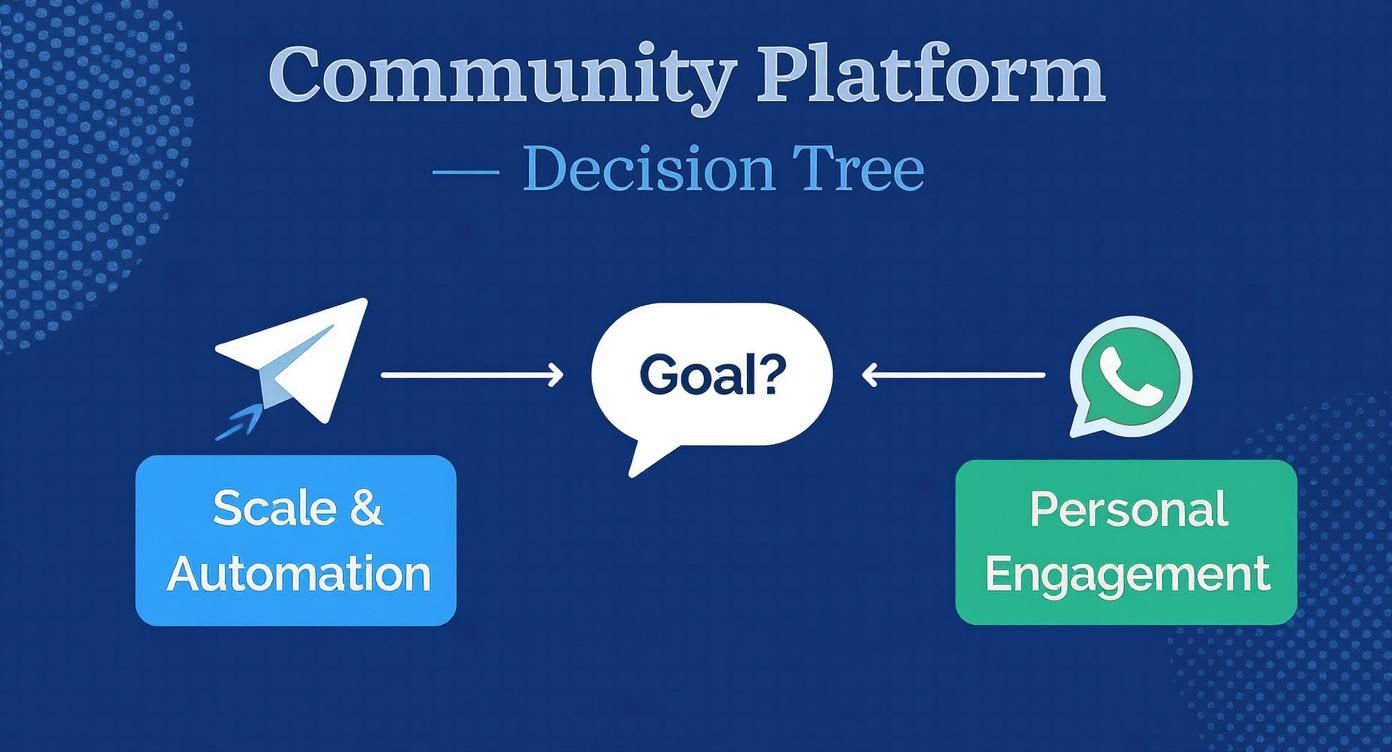
The takeaway is pretty clear: if you’re aiming for a large-scale operation with automated member management, Telegram is built for you. If you prioritise intimate, direct chats within a tight-knit group, WhatsApp feels much more natural.
Telegram vs WhatsApp: Key Differences for Creators
Before getting into the weeds, let's look at the big picture. For most creators, what really matters are things like group size limits, automation potential, and member privacy. These are the factors that will determine whether you spend your days wrestling with logistics or actually engaging with your members.
Here's a quick look at the critical differences that define the experience on each platform.
| Feature | Telegram | |
|---|---|---|
| Max Group Size | A massive 200,000 members | Capped at 1,024 members |
| Automation & Bots | Powerful API for bots and third-party tools | Very limited; mostly manual management |
| Member Privacy | Members can hide their phone number | Phone numbers are visible to admins |
| File Sharing Limit | Up to 2 GB per file (with cloud storage) | Up to 2 GB per file (stored on device) |
| Discoverability | Public channels are searchable | No public discovery; invite-only |
This table makes it obvious: while they're both messaging apps, they serve completely different purposes for community builders. Telegram is an engine built for broadcasting to and managing huge audiences. WhatsApp, on the other hand, remains a tool for closed, personal conversations.
There's another crucial factor to consider: where your audience already lives. In France, for example, WhatsApp’s dominance is absolute. As of Q3 2024, it boasts a 66.6% usage penetration among French internet users, making it the country's second most popular messaging app. Telegram isn't even close. If your audience is heavily concentrated in France, they're already on WhatsApp, making it the path of least resistance. You can dig into more French messaging app statistics on Statista.
When you look past the surface, managing a community on Telegram versus WhatsApp feels like using two completely different tools. To figure out which one is right for your paid community, you have to dig into the features that directly affect how you scale, moderate, and actually talk to your members. The differences aren't just about numbers; they reveal a deep split in how each platform sees its purpose.

This Telegram vs WhatsApp debate almost always starts with scale, and for a good reason. It’s the first and biggest roadblock for any community with ambitions to grow.
Scale and Structure: A Tale of Two Philosophies
The most glaring difference is the sheer capacity for growth. Telegram was built for massive audiences, allowing its "supergroups" to hold up to 200,000 members. This makes it the obvious choice for creators who already have a big following or are planning for some serious expansion down the line.
WhatsApp, on the other hand, caps its groups at a much cozier 1,024 members. It's a big jump from their old limits, but it still frames WhatsApp as a tool for smaller, more intimate circles, not huge communities. A creator trying to manage 5,000 paying members would have to juggle five different WhatsApp groups, which is a recipe for logistical chaos and a fractured member experience.
Telegram takes this a step further with its unique Channels feature:
- Telegram Channels: Think of these as a one-way broadcast tool for an unlimited number of subscribers. Only admins can post, which is perfect for announcements, newsletters, or content drops without all the chatter from member replies.
- WhatsApp Broadcasts: The closest thing WhatsApp has is a broadcast list, but it's limited to 256 contacts, and every single one of them needs to have your number saved. It’s designed for personal updates, not scalable community announcements.
This structural difference is a game-changer. A creator can use a Telegram Channel for core content and link it to a separate Telegram Group for discussion. This creates a clean, organised ecosystem that's just impossible to build on WhatsApp.
Advanced Administrative Controls
Running a community isn’t just about how many people you can fit in a room; it's about maintaining order. This is another area where Telegram’s toolkit for creators leaves WhatsApp in the dust. Telegram gives you a sophisticated dashboard to fine-tune the member experience.
WhatsApp's admin controls are basic. You can make someone else an admin and decide who can post or edit the group info. It works for a small group of friends, but it lacks the nuance you need to effectively manage a large, paying community.
Telegram, however, gives you much deeper control.
As a creator, your time is your most valuable asset. Telegram’s advanced controls and automation are designed to give you that time back, allowing you to focus on creating content instead of manually managing members.
Here’s a quick breakdown of what you can control:
| Admin Control Feature | Telegram | |
|---|---|---|
| Granular Permissions | Customise exactly what members can do (send messages, media, polls, add users, etc.). | Basic admin promotion; all non-admins have the same permissions. |
| Anonymous Admins | Admins can post on behalf of the group, hiding their personal account. | All admin posts are tied to their personal profile and phone number. |
| Slow Mode | Set a cooldown timer between messages to prevent spam and keep fast-moving chats under control. | No such feature exists. |
| Member Management | See a log of recent admin actions, give admins custom titles, and manage a blocklist with precision. | Limited to just adding or removing members. |
These aren't just nice-to-haves; they're essential for keeping a large community healthy and high-quality. For example, a creator running a trading signals group can use "anonymous posting" to send out official alerts without plastering their personal account everywhere, adding a layer of professionalism and security.
Automation Through Bots and APIs
This might be Telegram's single biggest advantage: its open API and massive ecosystem of bots. These are little automated programs that can handle a huge range of tasks inside your group, turning manual chores into a set-it-and-forget-it system.
WhatsApp has a Business API, but it's restrictive, expensive, and just not built for community-level automation in the same way. For the average creator, real automation on WhatsApp is a non-starter without clunky, often unofficial workarounds.
Telegram bots, in contrast, can handle almost anything:
- Welcome Bots: Greet new members automatically with a custom message and your community rules.
- Moderation Bots: Scan for and delete spam, filter out profanity, or kick users who break the rules.
- Content Bots: Schedule your posts, run polls, or pull in content from external feeds.
- Utility Bots: Translate messages, set reminders, or create custom commands just for your group.
For a paid community, this is transformative. When you connect Telegram to a service like Join My Thread, the entire member lifecycle—from taking payment and granting access to removing them if a subscription lapses—can be fully automated. This is the secret to scaling a monetised community without burning out. It’s a capability that WhatsApp simply doesn't offer.
Evaluating Privacy and Security for Members
When members pay to join your community, they're not just buying content; they're trusting you with their data. How you protect them is paramount, and in the Telegram vs WhatsApp debate, their approaches to privacy couldn't be more different.
Both platforms offer solid protection, but their core philosophies shape how that security works in practice. Understanding these nuances is crucial because your choice directly impacts the anonymity and safety you can offer, which is the foundation of trust in any paid group.
The Encryption Debate: End-to-End vs. Cloud
At the heart of the security discussion is encryption. WhatsApp built its reputation on default end-to-end encryption (E2EE) for every single chat and call. It uses the highly respected Signal Protocol, which means only the sender and recipient can ever read a message. Not even WhatsApp or its parent company, Meta, can get in.
This offers a powerful layer of always-on security. The catch? This device-centric model creates headaches for automation and multi-device syncing, which can really complicate community management.
Telegram takes a more flexible route. It has two distinct types of chats:
- Cloud Chats: These are the default for groups and channels. Messages are encrypted between your device and Telegram's servers, and then from their servers to the recipient. While secure, Telegram holds the keys. This prioritises seamless cloud sync across all your devices over absolute, impenetrable privacy.
- Secret Chats: These are optional one-on-one chats that do use E2EE. They can't be forwarded and aren't stored in the cloud, tying them to the specific device where they were started.
For any creator running a community, you'll be using cloud chats. While this brings up theoretical privacy questions, it’s also what enables the powerful bots, API access, and features that make managing a large group possible.
Member Anonymity: The Game-Changing Feature
Beyond encryption, the single biggest differentiator for community safety is how each platform handles user identity. This is where Telegram has a decisive edge for creators building paid groups where members might not know each other.
On WhatsApp, a member's phone number is their ID. To add someone, you need their number, and admins can see the number of every single person in the group. This is an immediate privacy red flag for anyone hesitant to share personal contact details with a group of strangers.
Telegram’s use of usernames decouples a member's identity from their personal phone number. This single feature is a cornerstone of building a safe, scalable community where members feel comfortable interacting without exposing private information.
Telegram lets users create a public username. People can join groups, chat, and interact using only this handle, keeping their phone number completely hidden from everyone—including you, the admin. For a paid community, this is a massive win. It lowers the barrier to entry for privacy-conscious members and fosters a safer environment where people aren't at risk of being contacted unsolicited.
This distinction is particularly relevant when you consider regional user habits. For example, WhatsApp’s huge popularity in France is part of a long-term trend; the platform grew from handling 1 billion messages a day in 2011 to over 140 billion by mid-2023. With around 25.1 million users in France alone, its network effect is undeniable. But that widespread use doesn't change the privacy trade-offs inherent in its phone number-based system.
Automating Monetization and Scaling Your Community

When your community shifts from a hobby to a business, the Telegram vs WhatsApp debate stops being about simple features and starts being about infrastructure. For creators, this is where the two platforms truly show their colours. The ability to automate payments and manage member access isn’t just a nice-to-have; it’s the engine that decides whether your community can scale sustainably or not.
This is where the core philosophies of each app become crystal clear. Telegram was built with an open, developer-friendly approach, which has allowed a rich ecosystem of tools to plug directly into its system. WhatsApp, on the other hand, remains a closed garden, prioritising personal communication over third-party integration—a choice that creates massive roadblocks for monetization.
The Power of Telegram’s API and Bot Ecosystem
Telegram’s biggest advantage for creators is its powerful Application Programming Interface (API) and the thousands of bots built on it. Think of the API as a secure bridge that lets external services interact with your groups and channels automatically. This is the secret to building a hands-off, scalable monetization system.
Imagine this workflow:
- Payment Collection: A potential member lands on your payment page (powered by a tool like Join My Thread) and subscribes.
- Automated Access: As soon as the payment goes through, the system's bot instantly adds the new member to your private Telegram group or channel.
- Ongoing Management: The bot keeps an eye on subscription statuses. If a member's payment fails or they cancel, it automatically removes them from the group.
For any creator serious about building a long-term, profitable community, automation is non-negotiable. Telegram's open API makes this level of operational efficiency not just possible, but straightforward to implement.
This is a world away from the manual reality of running a paid WhatsApp group.
The Manual Grind of a Paid WhatsApp Community
Running a paid community on WhatsApp is an exercise in manual labour. Because it lacks a robust, accessible API for community management, every single administrative task falls squarely on your shoulders. The whole process is inefficient, prone to error, and simply doesn't scale.
Just picture the daily reality for a creator managing a paid WhatsApp group:
- Tracking Payments: You have to manually check your bank or PayPal to see who’s paid, often cross-referencing names and payment details with a spreadsheet.
- Adding Members: Once you confirm a payment, you have to save the person's phone number to your contacts, then manually add them to the correct WhatsApp group.
- Revoking Access: When a subscription ends, it’s back to the spreadsheet to find the member and manually remove them. Forget this step, and you’re giving away your content for free.
This might be manageable with 20 members, but it becomes an administrative nightmare at 100. At 500, it's a full-time job that pulls you away from your actual business.
A Head-to-Head Comparison on Monetization Workflow
The difference in workflow isn’t just a minor inconvenience; it’s a fundamental split in scalability. One system is built for growth, while the other actively fights against it.
| Task | Telegram (with Automation Tools) | WhatsApp (Manual Process) |
|---|---|---|
| New Member Onboarding | Fully automated. Payment triggers an instant, automatic group invitation. | Completely manual. Requires payment verification, contact saving, and manual adding. |
| Access Revocation | Fully automated. Subscription cancellation or payment failure triggers instant removal. | Completely manual. Requires tracking subscription dates and manually removing expired members. |
| Error Potential | Low. The system handles all member management, eliminating human error. | High. Risk of adding the wrong person, missing a payment, or forgetting to remove someone. |
| Time Investment | Minimal. Set it up once and let it run. | Significant and growing. Administrative time increases with every new member. |
For any creator thinking about the long-term health of their business, this comparison makes the choice pretty clear. While WhatsApp may have a larger user base in certain regions, its structural limitations make it a poor foundation for a serious, scalable paid community. Telegram’s infrastructure, designed from the ground up to support automation, is the only viable path for creators who value their time and plan for growth.
Finding Your People: Community Growth and Discoverability
Automating payments is only one part of the puzzle. The other, arguably bigger, part is actually finding new members for your paid community. When it comes to Telegram vs WhatsApp, the way potential members can discover you is a massive difference. Your platform choice will determine whether your community’s growth is self-sustaining or completely dependent on your own marketing hustle.

This all comes down to their core design philosophy. Telegram was built from the ground up with public communication in mind, creating natural pathways for people to find you. WhatsApp, on the other hand, is a closed network by design, prioritising private conversations over public searchability.
Telegram’s Built-In Growth Engine
Telegram has several features that act like a built-in engine for community growth, letting potential members find you right inside the app. This creates organic discovery opportunities that just don't exist on WhatsApp.
The most powerful tool here is global search. Users can look up keywords related to their interests, and if your public channel or group name is optimised for those terms, you'll show up in the results. It's simple but incredibly effective.
Key discoverability features on Telegram include:
- Public Channels and Groups: You can set up a public channel with a unique, shareable link (like
t.me/yourbrand). This link gets indexed by Telegram's search, making you discoverable. - Searchable Usernames: Both personal accounts and channels can have a unique username. This makes them easy to find and share without ever having to give out a phone number.
- Channel Directories: While they're not official, countless third-party websites and even other Telegram channels act as directories, listing popular channels by topic and driving even more discovery.
This ecosystem means your community can grow passively over time as new users stumble upon it, taking some of the pressure off your marketing.
WhatsApp’s Walled Garden Approach
Growth on WhatsApp is a completely different ball game. It’s a closed system with absolutely zero internal discoverability. Nobody can search for your group, find it by topic, or accidentally come across it. Every single new member has to come through a direct link that you provide externally.
WhatsApp’s lack of discoverability places the entire burden of growth on the creator. Your community will only grow as fast as your ability to market your invitation link across other platforms like social media, your website, or your email list.
This makes WhatsApp a good fit for communities where exclusivity is the main draw, like a small coaching group fed from a carefully curated email list. But for creators trying to build a broader reach, it’s a constant and significant marketing hurdle.
Let's break down how people can find your community on each platform.
Community Growth Mechanisms Compared
| Growth Feature | Telegram | |
|---|---|---|
| In-App Search | Yes, users can search for public channels & groups by name or keyword. | No, there is no internal search for groups. |
| Public Usernames | Yes, t.me/username links are easy to share and find. | No, joining requires a phone number or a direct invite link. |
| Discoverability | High, through search, public links, and unofficial directories. | Non-existent; relies 100% on external promotion. |
| Growth Method | Organic & external promotion. | External promotion only. |
The table makes it clear: Telegram is built to help you get found, while WhatsApp requires you to bring everyone to the party yourself.
While Telegram has a smaller user base in France compared to WhatsApp's dominance, its features are perfectly geared toward niche community growth. Globally, Telegram has around 800 million active users. Even though WhatsApp boasts a 66.6% user penetration among French internet users, Telegram’s appeal to specific communities who value its advanced features makes it a powerful choice.
Making the Final Decision for Your Community
The whole Telegram vs WhatsApp debate isn't about finding the single "best" app. It's about picking the right tool for the job. Your final decision has to line up with what you're trying to build—your goals for growth, how you want to manage things, and the kind of experience you want members to have.
Let's make it simple: the platform you choose should match your ambition. Are you building a content empire or a close-knit mastermind group?
Choose Telegram for Scalability and Automation
If your plans involve serious growth and you value efficiency, Telegram is the obvious choice. Its entire infrastructure is built to support creators who want to build a large, monetised audience without getting bogged down in manual tasks.
You should be looking at Telegram if you're building:
- A large course community: Imagine thousands of students needing access to materials and discussion groups. Telegram handles that without you drowning in admin.
- A premium content hub: Perfect for delivering exclusive articles, videos, or signals to a huge subscriber base using organised channels.
- A scalable paid newsletter: You can leverage channels for clean one-way communication and use bots to handle all the subscription busywork automatically.
For most creators focused on long-term monetisation and growth, Telegram’s superior feature set gives it a clear and sustainable edge. It’s built to support your business, not just your conversations.
Choose WhatsApp for Intimacy and Direct Connection
On the flip side, WhatsApp shines where intimacy is worth more than sheer scale. Its simplicity and the fact that everyone already uses it make it the go-to for smaller, high-touch communities where direct, personal engagement is the main attraction. Here, its limitations actually become a strength, creating a more controlled and personal space.
Think about using WhatsApp for:
- A high-ticket mastermind group: A small number of clients pay a premium for direct access to you and close collaboration with each other.
- A local interest group: Maybe a fitness club or a neighbourhood watch where members likely already know one another.
- A personal coaching circle: Great for facilitating direct, almost one-on-one style communication within a small, supportive group.
In these cases, the lack of automation is a manageable trade-off because the platform is so familiar. Since explosive growth isn't the main goal, the manual work of adding and removing a few members here and there is perfectly feasible. The value comes from the group's exclusivity and the direct line of communication it offers—something WhatsApp’s straightforward interface makes effortless.
Frequently Asked Questions
Can I Actually Move My Community From WhatsApp to Telegram?
Yes, you absolutely can, but it’s more of a planned relocation than a simple data transfer. You can’t just import your WhatsApp chat history into Telegram. The real work is in convincing your members that the move is worth their while.
A smooth migration comes down to a few key steps:
- Sell the “Why”: Don’t just announce the move; explain the benefits. Talk about better privacy (no more shared phone numbers!), superior tools like polls and threads, and just a more organised space for everyone.
- Set a Firm Deadline: Give everyone a clear date for when the WhatsApp group will be archived. A little urgency goes a long way.
- Sweeten the Deal: Offering a small incentive—a free guide, a small discount for the first few who move—can make a huge difference in how quickly people follow you over.
Is It Really Safe to Take Payments on Telegram?
It's incredibly safe, but only if you do it the right way: with a trusted automation tool. Telegram itself doesn’t handle subscription payments. Instead, its powerful API lets secure services like Join My Thread manage the entire financial side of things for you.
These tools plug into proven payment processors like Stripe, so all the financial data stays locked down. The tool’s bot then automatically grants or revokes access to your group based on a member's payment status. This creates a secure, hands-off link between payment and access, and you never have to handle sensitive card details yourself.
Think of it this way: Telegram provides the space for your community, while dedicated tools provide the secure gateway for payments. That separation is what makes the whole system so robust and safe for creators.
Which Platform Is Better for Engagement?
Engagement isn't a one-size-fits-all metric; it looks completely different on each platform. WhatsApp’s raw simplicity is its strength. It encourages that direct, back-and-forth chat that feels personal and immediate, making it perfect for small, tight-knit groups.
But once you start scaling up, Telegram’s features are built to foster structured engagement in a way WhatsApp just can't.
- Threaded Replies: Stop important conversations from being buried under a flood of other messages.
- Polls and Quizzes: Get instant, organised feedback from hundreds or even thousands of members at once.
- Reactions: Let members acknowledge a message with a quick emoji instead of cluttering the chat with "Ok" or "Thanks."
So, while WhatsApp is king for intimate chats, Telegram gives you the tools you need to manage and spark engagement in a much larger crowd.
Ready to build a scalable, automated, and secure paid community? Join My Thread provides the essential tools to monetise your Telegram or WhatsApp group effortlessly. Set up your payment page in minutes and let our system handle the rest.