
How to Create a Sports Coaching Business with a Subscription Model
Published on February 17, 2026 · Reading time: 20 min
Building a subscription coaching model for your sports coaching business means swapping the unpredictable feast-or-famine cycle of one-off session payments for a steady, reliable income stream. Clients pay a recurring fee—usually monthly or yearly—for ongoing access to your coaching services, content, and community.
This simple shift is transformative. It allows you to move beyond just coaching; you start building a sustainable business focused on genuine, long-term athlete development. This guide will walk you through the steps to create your own sports coaching business, from identifying your expertise to choosing the right tools.
The Power of Predictable Coaching Revenue

Imagine your sports coaching business running less like a freelance hustle and more like a gym membership. Instead of constantly chasing new clients to fill single-session slots, you build a solid base of subscribers who pay you consistently every single month. That’s the core idea here.
This model breaks you out of the classic "time-for-money" trap, where your income is forever capped by the number of hours you can physically coach. By offering continuous value through a subscription, you create a scalable business that actually generates predictable revenue. That financial stability is freeing. It lets you stop worrying about filling the calendar and start focusing on what really matters: delivering exceptional coaching.
Why Subscriptions are a Game Changer for Sports Coaches
The subscription approach is a natural fit for sports. Let's be honest, real athletic progress is never made in a single session. It takes consistency, accountability, and a supportive environment over weeks, months, and even years. A subscription perfectly aligns with this long-term journey.
This ongoing relationship builds deeper trust and allows for more nuanced, adaptive coaching. You truly get to know your athletes’ strengths, weaknesses, and motivations, letting you fine-tune their training with incredible precision. For the athlete, it’s a clear commitment to their own growth, backed by consistent access to your expertise.
The real magic of a subscription model is its shift from transactional interactions to relational partnerships. When clients subscribe, they aren’t just buying your time; they are investing in a continuous process of improvement and a community that supports their goals.
Key Benefits for Your Coaching Business
Adopting a subscription model creates a win-win, reinforcing your business from the inside out with some very tangible advantages.
- Consistent Cash Flow: Predictable monthly recurring revenue (MRR) makes financial planning a breeze and your business far more sustainable.
- Increased Client Commitment: A subscription naturally encourages athletes to stay engaged, which leads to better results, killer testimonials, and a stronger reputation.
- Enhanced Scalability: You can serve more clients through group formats and digital resources without having to proportionally increase your direct coaching hours.
- Stronger Community: Subscriptions are fantastic for fostering a sense of belonging. Your client base transforms into a motivated community that learns and grows together.
Ultimately, this model helps you build a more resilient and impactful coaching business. You create an ecosystem where your financial success is directly tied to the continuous progress and engagement of your athletes. It just makes sense.
Step 1: Monetise Your Unique Coaching Expertise
The core of your business isn't a fancy app or a slick website—it’s you. Your expertise is the engine. The first step in building a killer subscription coaching model is figuring out exactly what knowledge you have that people will gladly pay for every single month. It's all about turning your unique skills into a service that people can't live without.
This starts with a hard look in the mirror. What do you do better than almost anyone? Maybe you have an uncanny knack for correcting running form, a strategic mind for football tactics, or the secret to a perfect golf swing. Whatever it is, that specific, proven skill is the foundation of everything you're about to build.
Identifying High-Demand Online Sports Niches
Let's be honest: not all expertise is a great fit for an online subscription. The most successful online coaches operate in niches where clients need ongoing guidance and can see real, measurable progress. This model is tailor-made for sports that are a blend of technique, fitness, and strategy.
So, which sports can be done online? Quite a few are a natural fit:
- Running and Fitness: This market is massive. Clients are always looking for the next training plan, nutritional advice, and the motivation to crush their next personal best.
- Yoga and Pilates: You can offer live-streamed classes, build a library of pre-recorded flows for different levels, and even give personalised feedback on form through simple video clips.
- Strength Training: Offer structured weightlifting programs, conduct form checks via video, and build communities around specific goals like powerlifting or bodybuilding.
- Technical Sports: Even sports that demand precision can thrive online. A martial arts sensei can analyse a student's kata via video, or a golf pro can break down a swing from a smartphone recording.
The trick is to find that sweet spot where your expertise solves a persistent problem or helps a specific group of athletes chase an ongoing goal. When you find it, you become the indispensable guide they need to get there.
Packaging Your Knowledge into Subscription Offerings
Once you've zeroed in on your niche, it's time to package your expertise into something tangible people can buy. You're not just selling "coaching"; you're selling a bundle of services that delivers constant value. This is where you can get creative and design an offer that feels both complete and essential.
Think about mixing and matching different elements to create a compelling package. Some popular options include:
- Custom Training Plans: Personalised weekly or monthly workout schedules that evolve as your athletes get stronger and closer to their goals.
- Personalised Video Feedback: Clients send you clips of their technique, and you send back specific, actionable critiques. This is pure gold.
- Nutritional Guidance: Meal plans, recipes, and solid advice on fuelling for performance and recovery.
- Mental Performance Coaching: Strategies for focus, resilience, and mindset delivered through guides, worksheets, or group calls.
Your goal is to create an entire ecosystem of support. The subscription should be more than a training plan—it should be a complete solution covering technique, conditioning, nutrition, and mindset. That’s how you become an irreplaceable part of their journey.
Pinpointing Your Ideal Client and Their Challenges
Finally, to actually make money from your expertise, you have to know exactly who you're selling to. Defining your ideal client—your "avatar"—is mission-critical. It shapes your marketing, your pricing, and the very services you offer. Get super specific about their demographics, skill level, goals, and, most importantly, their pain points.
What's keeping them up at night?
- Are they lost without a structured training programme?
- Have they hit a performance plateau they just can't break?
- Do they feel isolated and crave a supportive community?
- Are they overwhelmed by all the conflicting advice online?
Your subscription needs to be the direct answer to these problems. When your ideal client stumbles upon your offer, they should feel like you read their mind. By truly understanding what they're struggling with, you can show them how your unique expertise is the key to unlocking their success, making your monthly fee an easy "yes."
For a deeper dive into structuring your offer, you can explore various community monetization models to see what fits your style best.
Step 2: Design Your Subscription Tiers and Pricing
Once you know what expertise to monetise, the next critical step is packaging it. Getting your subscription tiers and pricing right is like laying the foundation for a house—do it well, and your entire business will be stable and ready to grow. Your goal is to create clear, compelling options that guide clients to the perfect choice for their needs and budget.
The beauty of the subscription coaching model is its flexibility. You’re not locked into a single way of doing things. Instead, you can design offerings that perfectly match your coaching style, your capacity, and what your clients are trying to achieve.
Think of it as a simple hierarchy: your core expertise fuels a specific niche, which then allows you to build a powerful offering on top.
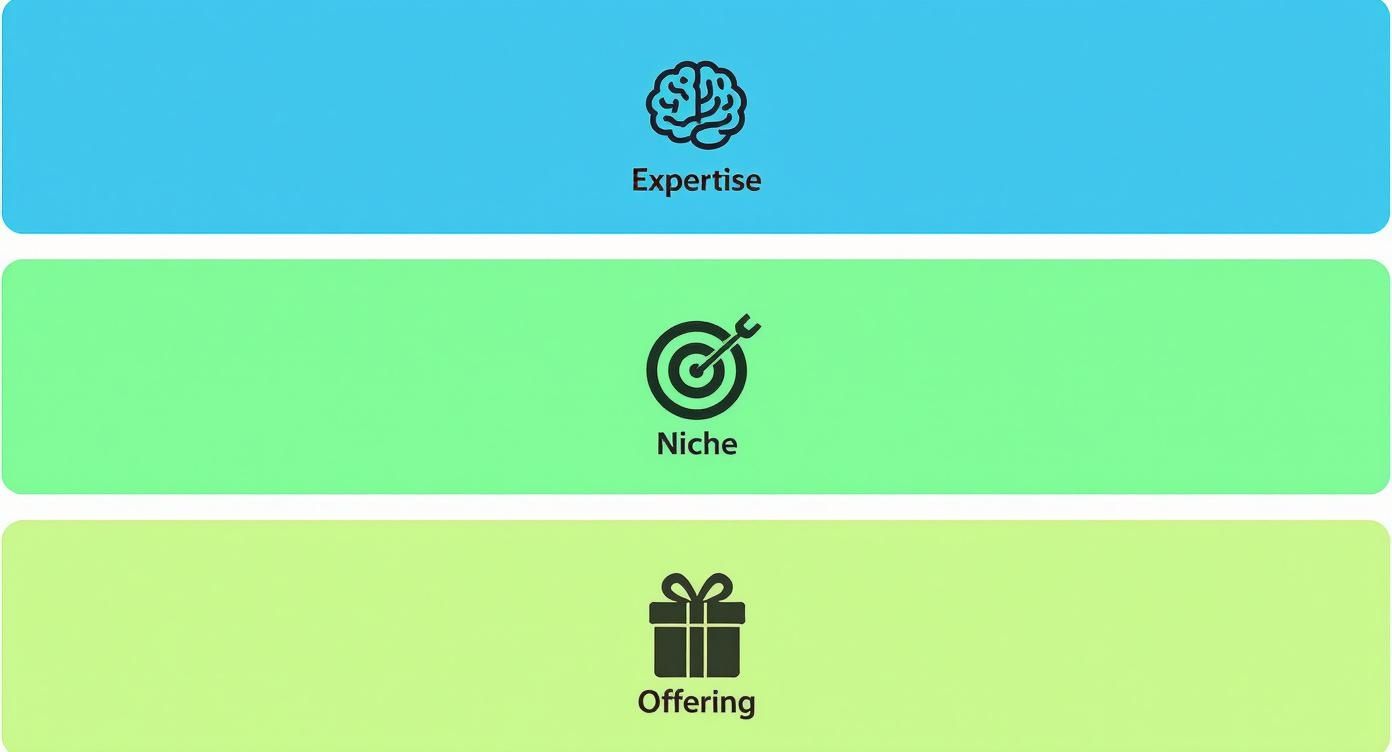
This visual makes it clear: a strong offering doesn’t just appear out of nowhere. It's built on a well-defined niche, which is powered by what you know best.
Common Subscription Coaching Formats
Let's dive into some of the most popular and effective formats out there. Each one has its own vibe, so think about which one best fits the experience you want to create for your clients.
- Tiered Access (e.g., Bronze, Silver, Gold): This is a classic for a reason. You offer different levels of access and support at various price points. A Bronze tier might give someone your content library and community access, while a Gold tier could add personalised video feedback and monthly 1:1 check-ins.
- All-Inclusive Group Programme: In this model, everyone pays the same fee and gets access to everything. This usually includes live group coaching calls, a complete resource library, community access, and maybe some themed monthly challenges. It’s fantastic for building a strong, unified community.
- High-Touch 1:1 Retainer: This is the premium, velvet-rope option for a handful of clients who want your full attention. They pay a significant monthly fee for direct, priority access to you, deeply personalised plans, and in-depth support. It’s low-volume but high-revenue.
Choosing the right format really comes down to how you want to spend your time and what’s the most effective way for you to deliver results.
Comparing Popular Subscription Coaching Models
To help you decide, let's break down the key differences in a simple comparison table. This will give you a clear picture of where each model stands in terms of client value, pricing, and your own time commitment.
| Model Type | Best For | Typical Price Point | Coach Involvement |
|---|---|---|---|
| Tiered Access | Coaches who want to serve a wide range of clients with different budgets and needs. | €25 - €150/month | Low to High |
| Group Programme | Building a strong, interactive community and delivering value at scale. | €75 - €250/month | Medium |
| 1:1 Retainer | Coaches with proven results who want to work closely with a few high-achieving clients. | €500+/month | Very High |
As you can see, there’s a clear trade-off. As your direct involvement goes up, so does the price point, but the number of clients you can realistically serve goes down. A well-balanced business might even offer a group programme with a 1:1 retainer as a premium upsell.
Setting Your Prices with Confidence
Pricing can feel intimidating, but it doesn't have to be. Your rates should reflect the transformation you provide, not just the hours you put in. Don't fall into the trap of charging too little; it devalues your expertise and tends to attract less committed clients.
A key shift in the coaching industry has been from transactional, one-time sessions to relationship-based subscriptions. This move is backed by strong market data, with subscription revenue streams now accounting for approximately 45.6% of the total life coaching market and growing annually. This model provides coaches with predictable income and fits well with how many clients prefer to manage their expenses. Discover more insights about this trend and its impact from market analysis by Mordor Intelligence.
Ultimately, your pricing strategy sends a message. It tells potential clients about the quality of your coaching and the results they can expect. Set prices that you are proud of, that support a sustainable business, and that attract the type of dedicated athletes you love working with.
Step 3: Choose Your Useful Coaching Tools

Let's be honest, the right technology is the secret weapon behind any subscription coaching model that doesn't burn you out. It’s the invisible engine that handles all the repetitive, soul-crushing admin, freeing you up to do what you actually love: coaching.
Building your "tech stack"—the collection of tools that run your business—doesn't have to be some complex, expensive nightmare. The whole point is to create a smooth, professional system that just works, both for you and your clients. Think of it as your behind-the-scenes crew, managing payments, granting community access, and scheduling sessions without you lifting a finger.
The Core Engine: Payments and Community Access
At the absolute heart of this whole operation is managing recurring payments and controlling who gets into your private community. This part is completely non-negotiable.
Trust me, manually chasing payments and adding or removing people from a WhatsApp group one by one is a direct path to burnout. It's also where mistakes happen. For this to scale, you need automation.
This is where a specialised tool is worth its weight in gold. You need a system that connects a bulletproof payment processor to your community platform. For instance, a platform like Join My Thread was built for exactly this. It hooks directly into Stripe —the gold standard for secure payments—to manage subscriptions for your private WhatsApp or Discord groups.
When a client signs up, the system automatically adds them. If their payment fails or they cancel, it boots them out. This single automation solves the biggest administrative headache for any community-based coach.
This simple setup guarantees only paying members are in your space, protecting the value of your offer and saving you hours of tedious work every single week. It’s the foundation of a modern coaching business.
Essential Tools for Delivering Value
Once you've nailed payments and access, a few other tools are critical for delivering a coaching experience that people are happy to keep paying for. These platforms help you give personalised feedback, share structured content, and make communication ridiculously easy.
Here are the key pieces of the puzzle to consider:
- Client Scheduling: To kill the endless "what time works for you?" email chain, get a scheduling tool like Calendly or Acuity Scheduling. You just set your availability, and clients book their 1:1s or check-ins from a simple link. Problem solved.
- Video Analysis and Feedback: For any coach in a technical field—golf, martial arts, running, you name it—video feedback is a game-changer. A tool like Loom lets you record your screen and voice over a client's video, giving them crystal-clear critiques they can watch over and over.
- Content Delivery and Resource Hubs: You need a central, organised spot for all your training plans, video tutorials, and nutritional guides. This doesn't need to be fancy. A private area on your website, a clean Google Drive folder, or a simple Notion workspace works perfectly as a resource library.
Putting It All Together: A Sample Tech Stack
Look, you don't need a dozen expensive tools to get started. You can build a lean, mean, effective stack that covers all your bases from day one.
A battle-tested setup for a new sports coach could look something like this:
- Monetisation and Community:Join My Thread to automate Stripe payments and manage access to your WhatsApp or Discord community.
- Scheduling:Calendly's free plan is more than enough to handle booking 1:1 check-ins.
- Video Feedback:Loom is perfect for recording personalised swing analyses or form corrections.
- Content Hub: A shared Google Drive folder organised with welcome guides, training plans, and video libraries.
This simple combination gives you a powerful, low-cost foundation. It automates the grunt work and gives you the tools you need to deliver incredible value, letting you focus on building a killer subscription coaching business.
Step 4: Keep Your Community Alive and Engaged

A top-notch training plan is the price of entry. That’s the bare minimum. But a lively, engaged community? That’s what makes a subscription coaching model an unmissable part of a client's life. It's the magnet that keeps them showing up, pushing forward, and happily renewing, month after month.
Think about it like this: your coaching is the map, but the community is the group of fellow travellers. They provide the encouragement, the shared stories, and the accountability that makes the entire journey feel worthwhile. When clients feel like they truly belong, your service stops being a simple transaction and becomes their support system. That’s the secret to long-term retention.
The coaching industry has absolutely exploded, with the number of coaches more than doubling since 2019. This boom is fueled by remote and hybrid coaching, which has torn down geographical walls and made personalised guidance more accessible than ever. You can dig into the rapid expansion of the coaching industry on RobinWaite.com. In such a crowded field, your community isn't just a nice-to-have—it's your single greatest advantage.
Foster Connection with Member-Only Challenges
Want to build camaraderie fast? Get people working towards a shared goal. Member-only challenges are perfect for this. They create a focused, time-sensitive event that naturally sparks conversation, friendly competition, and mutual support.
The best part is, they don't have to be complicated. Simple is usually better for getting everyone involved.
- Consistency Challenges: Think a "30-Day Run Streak" or "Complete 15 Workouts This Month." These are great for encouraging daily check-ins and progress updates in your community chat.
- Performance Goals: A "Beat Your 5k Time" challenge gets members sharing their training runs and celebrating personal bests together at the end of the month.
- Skill-Based Contests: For more technical sports, you could do a "Best Form Video" submission. This generates helpful peer feedback and a bit of healthy competition.
The real aim here is to create an event where everyone, no matter their skill level, can jump in and feel like they’ve achieved something.
Create a Rhythm with Live Interactive Sessions
Sure, pre-recorded content is scalable, but real connection happens live. Regular, interactive events give your community a pulse. They provide members with direct access to you and, crucially, to each other, making your subscription feel alive and dynamic.
Building a community isn't about creating a passive audience; it's about facilitating active participation. Your role is to create the space and opportunities for members to connect with you and, more importantly, with each other.
Try scheduling a mix of live events to keep things interesting. A weekly "Office Hours" or Q&A session is fantastic for letting members ask anything that's on their mind. You can also throw in monthly workshops or bring in guest experts on relevant topics to add massive value and give everyone a reason to show up.
Empower Members with Peer-to-Peer Support
Your ultimate goal is to create a community that practically runs itself—an ecosystem where members are supporting each other. While you're always the expert guide, encouraging peer-to-peer interaction empowers your clients and makes their bond with the group even stronger.
This is how you shift from being a top-down source of information to facilitating a collaborative network.
You can nudge this along by creating specific channels or threads on platforms like Discord for topics like "Gear Talk," "Race Reports," or "Weekly Wins." Actively prompt members to share their own experiences and answer each other's questions.
And when you see a member give a fantastic piece of advice? Give them a public shout-out. This small act reinforces just how valuable peer support is and encourages everyone else to get involved. Do this consistently, and you'll build an unbeatable community that members won't want to leave.
Mastering Client Onboarding and Retention
Getting a new subscriber is a great start, but keeping them is how you build a real business. A solid onboarding process isn't just a nice-to-have; it's your best tool for retention. It sets the tone from day one and proves your value the moment someone signs up. Your goal is to make every new client feel instantly welcomed, seen, and sure they made the right decision.
That initial experience is everything. A clumsy or confusing start makes new members feel lost and second-guess their investment. But a smooth, structured welcome sequence shows you're a pro and gets them their first "win" fast. That early victory is what locks in their commitment to your programme.
Crafting a Winning Onboarding Experience
Great onboarding is so much more than a welcome email. It's a deliberate sequence designed to plug new members straight into your community and coaching ecosystem. This is your moment to manage expectations, give clear instructions, and get them fired up for what's ahead.
A killer onboarding flow needs to nail a few key things:
- Give a Warm Welcome: A personal video or message from you makes a world of difference. It puts a face to the programme and makes the whole thing feel more human.
- Deliver a "Quick Win" Asset: Hand them something they can use right now to see value. Think a foundational training video, a simple progress tracker, or a guide to common mistakes in their sport.
- Explain How Everything Works: A simple checklist or guide showing them where to find resources, how to join the community chat, and when live calls are. Clarity is kindness.
This proactive approach turns a simple payment into the beginning of a real coaching relationship.
Long-Term Strategies for Client Retention
Once your clients are settled in, your focus shifts to proving your value month after month. Retention in a subscription coaching model comes down to three things: consistent engagement, visible progress, and a strong sense of community. When clients feel connected and see tangible results, cancelling becomes a much harder choice.
In the digital health coaching space, subscription services are the engine of success, with nutrition coaching often being a top revenue driver. The model works because it encourages continuous client contact, making it easier to offer ongoing guidance and tweak programmes for better long-term results and stronger coach-client bonds. You can read the full research about digital health coaching trends here.
To maximise the lifetime value of every subscriber, you have to actively work to keep them motivated.
Your job isn't just to hand over a plan; it's to create an environment where progress is inevitable and celebrated. Retention is a direct result of the value and support you consistently deliver.
Here are a few proven tactics:
- Track and Celebrate Progress: Keep an eye on your clients' improvements and give them public shout-outs for their hard work. Celebrating wins, big or small, is a massive motivator.
- Actively Solicit Feedback: Regularly ask your clients what they love, what they’re struggling with, and what they want more of. Not only does this make them feel heard, but it gives you priceless intel to make your service even better.
- Keep Content Fresh and Engaging: Roll out new monthly challenges, bring in guest experts for a session, or add new resources to your library. Stagnation is the enemy of retention; always give your members something new to look forward to.
Got Questions? We've Got Answers
Stepping into the world of subscription coaching can feel like venturing into new territory. It's totally normal to have a few questions buzzing around. Here are some straight-talking answers to the most common queries we hear from coaches just like you.
How Much Content Do I Really Need to Launch?
Honestly? A lot less than you probably think.
Your goal isn't to build a massive, Netflix-style library of content from day one. Instead, focus on creating a small, high-impact starter pack that gives your new members a quick, tangible win. It's all about proving your value right out of the gate.
A great starting point could just be:
- A simple welcome guide that lays out the game plan.
- One or two core training videos covering the absolute essentials.
- A basic tracker or checklist so they can see their progress immediately.
That's it. Your content library will grow organically over time, shaped by what your community actually needs and asks for. Start small, deliver a win, and build from there.
How Do I Stop People From Cancelling?
Retention is the name of the game, and it all boils down to making your subscription an unmissable part of your client's life. When people feel connected and see real results, leaving isn't even on their radar.
To keep churn low, zero in on these three things:
- Celebrate Their Wins: Acknowledge member progress publicly (with their permission, of course!). A simple shout-out can be a huge motivator and powerfully reinforces the value of what you do.
- Build a Real Community: Create a space where members genuinely support and root for each other. That feeling of belonging is incredibly sticky and often becomes the main reason people stay.
- Keep Things Fresh: Don't let the experience get stale. Regularly introduce new content, run monthly challenges, or host live Q&A sessions. A little novelty goes a long way in keeping people engaged and excited.
What’s the Easiest Way to Handle Recurring Payments?
Automated payments are non-negotiable. Seriously. Trying to chase down payments manually is a fast track to burnout and looks unprofessional. The gold standard for securely handling subscriptions is a payment processor like Stripe.
The smartest move is to connect your payment processor directly to your community platform. This simple automation is the key to getting your time back and giving your clients a seamless experience.
A tool like Join My Thread is a game-changer here. It hooks Stripe directly into your WhatsApp or Discord group, automatically adding members when they pay and removing them if a payment fails. Think of all the admin hours that saves you every single month.
Ready to put your coaching business on autopilot and build a community that pays? With Join My Thread, you can manage paid subscriptions for WhatsApp and Discord groups without the headache. Set up your monetisation system in minutes.