
Convert Followers Into Paying Members: Proven Strategies for Revenue Growth
Published on March 11, 2026 · Reading time: 14 min
Before anyone will even think about paying you, they need to be completely sold on the idea that your membership is the exact solution they’ve been looking for. This isn't about flashy sales tactics; it's about creating something that genuinely solves a problem for them.
The first, most crucial step? Stop guessing what your audience wants and start listening.
Your DMs, comment sections, and story replies are a goldmine. What questions pop up again and again? What struggles do your followers keep mentioning? These aren’t just random interactions—they're a direct line into what people would happily pay you to solve.
Building a Membership Your Audience Actually Wants
Pinpoint the Core Problem You Solve
Every great membership helps members achieve a specific transformation. Your free content probably covers the “what” and the “why,” but your paid community needs to deliver the “how.”
Think about it this way: a fitness influencer might share free workout tips on Instagram. That’s great for awareness. But their paid community? That's where they offer structured monthly programmes, personalised form checks, and accountability groups that actually get people results.
The real secret is shifting from scattered information to a structured pathway. People don't pay for more content; they pay for outcomes, organisation, and access.
To really nail your value proposition, get honest with yourself:
- What's the single biggest challenge my followers have that I’m uniquely positioned to help with?
- What tangible result can they realistically get by joining my community?
- What exclusive resources, tools, or support can I offer that they can't get for free?
Answering these questions brings clarity. Suddenly, you’re not just selling “coaching calls.” You're offering “weekly strategy sessions to help you land your first 3 clients.” That specificity is what makes people buy.
Structure Tiers That Guide the Customer Journey
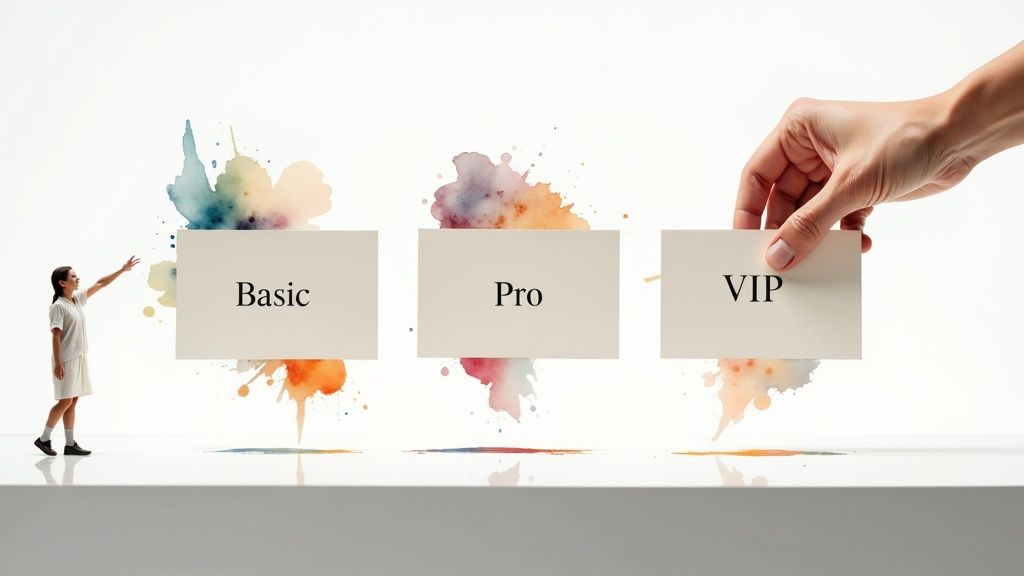
Let's face it: not all followers are ready for the same level of commitment or price point. That’s where a tiered membership structure comes in. It lets you meet people exactly where they are, giving them multiple ways to join your world. A three-tier system is a classic for a reason—it just works.
1. The Entry-Level Tier (Basic)
This is your “foot in the door” offer. It’s designed to be a no-brainer for followers who are curious but maybe not ready to drop a lot of cash. The key is to offer clear value that’s a step up from your free stuff, but still leaves them wanting more.
- For example: A community for language learners might offer a basic tier with access to a private Discord group and a weekly vocabulary list. Simple, valuable, and low-risk.
2. The Core Offer Tier (Pro/Standard)
This is your bread and butter. It's where you expect most of your members to land because it provides the complete solution to the core problem you identified. It should include everything from the basic tier plus all the key features needed to get that transformation.
- For example: The same language learning community’s Pro tier could add monthly live practice sessions, access to a full resource library, and conversation partners. This is the whole package for someone who’s serious about becoming fluent.
3. The Premium Tier (VIP/Elite)
This tier is for your super-fans—the ones who want the highest level of access and personalisation. We're talking direct access to you, whether that’s through one-on-one coaching, detailed feedback on their work, or small-group masterminds. The price has to reflect this exclusivity and high-touch support.
- For example: The VIP tier might throw in a monthly private tutoring session and direct message support for personalised questions, on top of everything from the Pro tier.
This tiered approach doesn't just cater to different budgets. It creates a natural upgrade path, keeping members around for the long haul as they get more invested and start looking for that next level of support. It's a foundational strategy to effectively convert followers into paying members, no matter where they are on their journey.
Warming Up Your Audience For a Killer Launch
A membership launch that feels like an overnight success is never an accident. It’s the result of weeks of groundwork, carefully stoking anticipation until your followers aren't just aware of your offer—they're lined up, waiting for the doors to open.
This pre-launch phase is your secret weapon. It’s where you turn passive scrollers into genuinely excited, ready-to-buy members.
It all starts with a subtle shift in your content strategy. Move away from just sharing generic tips and start telling stories about the specific problems your membership will solve. Talk openly about the frustrations, the roadblocks, and the goals you hear about from your audience every single day.
This does one crucial thing: it primes them to recognise the need for a solution. So when you finally unveil your membership, it doesn't land like a random sales pitch. It feels like the perfect, welcome answer to a conversation you’ve been having with them all along.
Get Your Followers to Help You Build It
Here’s a simple truth: people support what they help create. One of the most effective ways to build that pre-launch buzz is to make your audience feel like they have a real stake in what you're building. This co-creation process isn't just for show; it builds incredible trust and makes the final offer feel like it was designed just for them.
You can do this with simple, interactive content you’re probably already making:
- Run some Instagram Story polls: Ask direct questions like, “Which workshop topic would you find more helpful right now: A or B?” or “What’s your single biggest headache with [your niche]?”
- Host a Q&A session: Dedicate a Live or an entire Story series to answering questions about the problems your membership tackles. This is a great way to showcase your expertise while gathering priceless insights.
- Share the messy middle: Post quick videos of you sketching out a module, designing a workbook, or even just setting up your community space. It makes the whole project feel real, tangible, and exciting.
This isn’t just about boosting your engagement metrics. You’re essentially turning your audience into a live focus group, making absolutely sure the thing you build is the thing they actually want to buy.
Weave in Scarcity and Exclusivity
Once you’ve established the problem and invited your audience into the process, it's time to introduce a bit of urgency. This isn't about using fake pressure tactics. It's about framing your launch as a special event—a unique opportunity that rewards people for taking action.
The goal is to make joining feel like an unmissable event, not just another online purchase. By limiting availability or stacking the deck with special incentives, you encourage your most dedicated followers to jump in right away, giving your membership the strong start it needs.
Think about using these kinds of tactics to build that “can't miss” feeling:
- Start a waitlist: Make it clear that people on the waitlist will get early access, a special “founder's price,” or an exclusive bonus that no one else gets. It’s a brilliant, low-pressure way to gauge real interest and collect leads before you even open the cart.
- Announce a limited capacity: This works especially well if you're offering high-touch support. Simply stating that you're only accepting a small group of “founding members” instantly makes the offer feel more exclusive and valuable.
- Tease some launch-only bonuses: Hint at valuable extras—a bonus workshop, a 1:1 call, a special guide—that will disappear forever once the initial launch window closes.
This kind of strategic build-up is absolutely vital in crowded markets. Take the French e-commerce landscape, for example. The average visitor-to-customer conversion rate is a tough 1.10%. And yet, the sector still pulled in a massive €159.9 billion. That tells you that even with low baseline conversions, targeted and compelling strategies can drive incredible results.
Your pre-launch strategy is precisely how you beat those averages and effectively convert followers into paying members. You can dig into more insights about e-commerce benchmarks in France to see just how powerful this can be.
Designing Your High-Conversion Sales System
A brilliant membership idea is only half the battle. Without a solid system to turn interest into actual payments, even the best offers just fizzle out. This is where you build the engine that powers your business, converting casual followers into committed, paying members.
Your sales system isn’t just a checkout page. It’s the entire journey a follower takes, and it has to feel seamless, trustworthy, and exciting.
The absolute heart of this system is your landing page. This single page has one job and one job only: convince a potential member that joining is the best decision they can make today. It needs to be sharp, compelling, and totally focused on the transformation you’re offering. Everything else—your emails, your social posts—is designed to get people to this page.
Anatomy of a High-Performing Landing Page
Think of your landing page as your best salesperson, working for you 24/7. It needs to sell your vision perfectly without you having to say a word. Every single element must push towards one goal: getting that sign-up.
Here are the non-negotiable parts you have to get right:
- A Killer Headline: This is the first thing people see. It must grab their attention and shout the number one benefit of joining. Instead of something bland like “Join My Community,” go for an outcome: “The Ultimate Community for Creators Ready to Triple Their Income.”
- Benefit-Driven Copy: Forget long lists of features. Your followers don't care about features; they care about what those features will do for them. Translate everything into a tangible benefit. For instance, “Weekly Q&A Calls” becomes “Get Your Biggest Business Questions Answered Live by an Expert Every Week.”
- Compelling Social Proof: People trust other people more than they trust you. It's just human nature. Sprinkle in screenshots of glowing DMs, testimonials from beta testers, or shout-outs you’ve received. This builds instant credibility and melts away that “should I buy this?” anxiety.
- A Crystal-Clear Call-to-Action (CTA): Your sign-up buttons need energy. Use bold, action-oriented language. “Join Now,” “Become a Founding Member,” or “Start My Transformation” are way more powerful than a passive “Submit.”
Your landing page shouldn't feel like a sales pitch. It should feel like a solution. Every word, image, and testimonial should work together to build a powerful case that joining is the obvious and exciting next step.
The image below shows a simple but powerful three-step process to warm up your audience before they even hit your landing page.
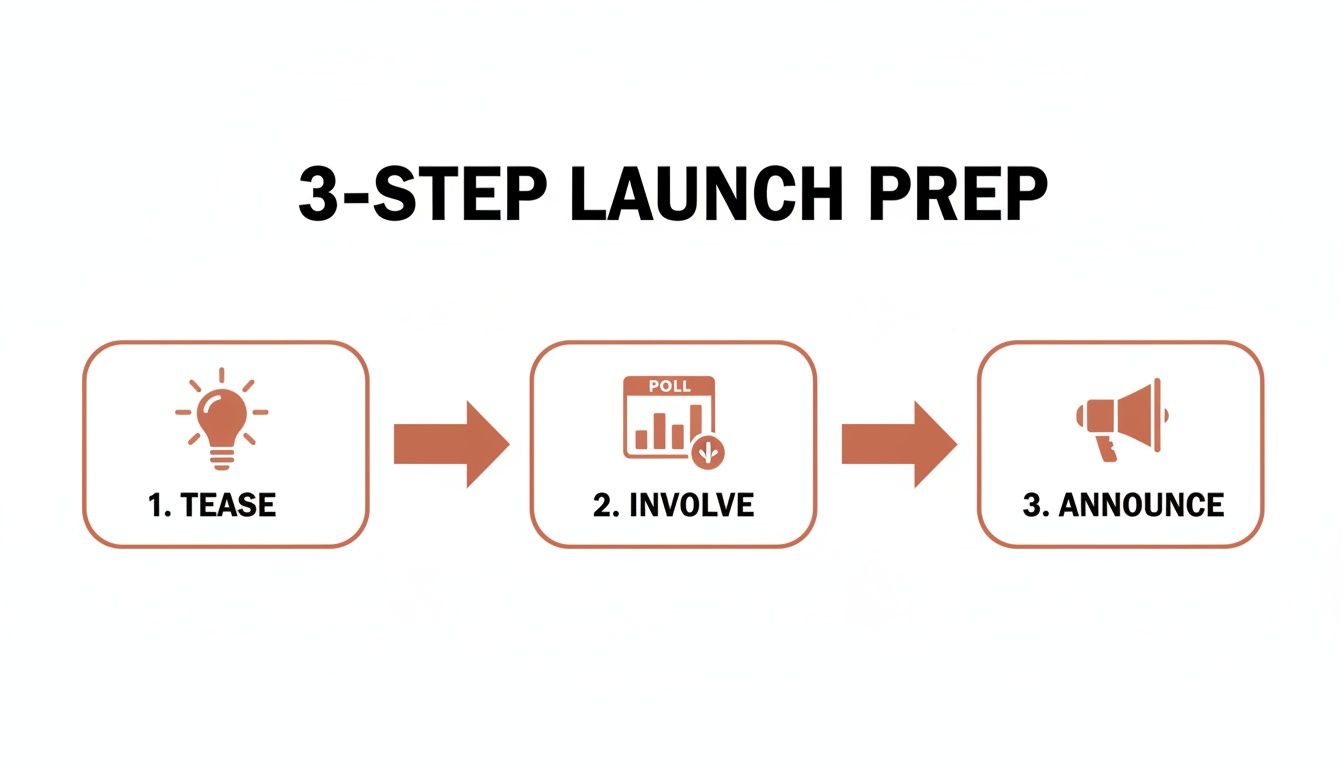
This simple flow—teasing the idea, involving your community in its creation, and then making a clear announcement—makes a world of difference. When you finally share the link, your audience is already primed and eager to see what's inside.
Building Your Automated Conversion Funnel
Once your landing page is live, you need a system to guide people there consistently. This usually means an email nurture sequence—a series of automated emails sent to anyone who shows interest, maybe by joining a waitlist. This is your golden opportunity to build a real connection, far away from the noise of a social media feed.
Your email sequence should strategically walk them through the decision-making process:
- Welcome and Reinforce the Vision: The first email should land instantly. Thank them for their interest and get them excited all over again about the transformation you promised.
- Handle Objections Head-On: Dedicate an email to tackling the biggest “what ifs.” What if I don't have enough time? What if I'm a total beginner? Answer these questions honestly and directly.
- Showcase Real Proof: Share a powerful testimonial or a mini case study. Let a happy member do the selling for you. Their words are always more convincing than yours.
- The Final Push: The last email creates a bit of urgency. Remind them of any launch-only bonuses or that the doors are closing soon.
When planning your strategy, it helps to understand where your efforts will pay off the most. Not all channels are created equal when it comes to turning a follower into a customer.
Key Conversion Channels and Performance
This table breaks down typical conversion rates across different channels in France, giving you a clue about where to focus your energy. Trust and direct communication almost always win.
| Channel | Typical Conversion Rate (France) | Strategic Focus |
|---|---|---|
| Referrals | 5.4% | Encourage existing members to share. Build a strong community vibe that people want to talk about. |
| Direct Website Traffic | 2.5% | Your landing page is critical. Ensure it's clear, fast, and optimised for conversion. |
| Email Marketing | 1.8% | Nurture your waitlist with value-packed emails that build trust and handle objections. |
| Organic Search | 1.2% | While a long-term play, optimising your site for relevant keywords can bring in high-intent visitors. |
| Social Media | 0.7% | Use social media to build awareness and drive traffic to your email list/waitlist, not for direct sales. |
The data is clear: relying solely on social media for sales is tough, with conversion rates hovering at a low 0.7%. In contrast, referrals and direct traffic perform exceptionally well because they are built on a foundation of trust. Your email funnel is the perfect tool for building that trust systematically. For a deeper look, check out the full data on French e-commerce conversion rates.
Finally, the tech side of things has to be invisible and flawless. This is non-negotiable.
Platforms like Join My Thread are built specifically for this, automating the payment process and member access to your WhatsApp or Discord groups. It completely removes the friction at that final, critical step. When a follower clicks “Join,” the system should handle the payment through a trusted provider like Stripe and instantly grant them access. This automation not only saves you countless hours of admin headaches but also delivers the professional, smooth experience that new members expect and deserve.
Automating and Optimizing for Long-Term Growth
Getting your first few members through the door is a massive win. Seriously, pop the champagne. But once the launch confetti settles, the real work begins. To build a community that lasts, you have to shift your focus from short-term tactics to long-term health.
This is where automation and optimisation become your secret weapons.
By setting up systems that hum along quietly in the background, you claw back time from soul-crushing admin. That frees you up to focus on what you actually love doing: creating amazing content and connecting with your people. It’s the difference between being on a constant treadmill of chasing new sign-ups and building a thriving, self-sustaining business.
Automate the Entire Member Lifecycle
Think about the journey your members take. They join, they get onboarded, they get billed, and hopefully, they renew. Every single one of these touchpoints can (and should) be automated to create a slick, professional experience that builds trust from day one.
When someone decides to join, that process needs to be instant. No friction. Tools like Join My Thread are built for exactly this. It connects to Stripe for payments and automatically grants access to your private WhatsApp or Discord group. No more manually vetting people or sending invite links at 2 a.m. You can literally convert followers into paying members while you sleep.
Here are the key workflows you need to get on autopilot:
- The Welcome Sequence: The second someone pays, an automated welcome email should land in their inbox. This email does three things: confirms their purchase, tells them exactly what to do next, and gets them pumped to be part of the crew.
- The Onboarding Flow: Don't just dump new members in the deep end. A short series of automated emails over the first week can be a game-changer. Introduce them to key resources, lay out the community ground rules, and nudge them to make their first post.
- Payment & Renewal Nudges: Failed payments are a silent killer of membership businesses. An automated system can send a polite heads-up before a subscription renews and alert members if a payment fails, giving them a chance to update their card without you having to chase them down.
- Renewal Campaigns: For annual members, an automated email sequence that kicks in a month before renewal is crucial. Remind them of all the value they’ve received and make renewing a no-brainer.
This isn’t just about being efficient. It’s about making every single member feel seen and supported, even when you’re managing hundreds of them.
Test Everything to Improve Performance
Okay, so your systems are running. Now it’s time to start tinkering. The goal here is to make small, data-backed improvements that stack up over time, leading to serious growth. This is where you put on your lab coat and start A/B testing.
A/B testing (or split testing) is simple: you create two versions of something—a landing page headline, an email subject line, a button—and show them to different people to see which one works better.
The most successful creators I know don't guess. They treat their membership like a living, breathing thing. They are constantly testing, learning, and tweaking their approach based on how real people are actually behaving.
Here are a few high-impact things you can start testing right away:
- Landing Page Headline: Pit a benefit-driven headline (“The Proven System to Land Your First 3 Clients”) against a community-focused one (“Join 200+ Freelancers Growing Their Business Together”).
- Email Subject Lines: Try a straightforward subject line (“Your Weekly Community Roundup”) against one that sparks curiosity (“This week's biggest member win...”).
- Call-to-Action (CTA) Text: Test your button copy. Does “Join the Community” pull better numbers than “Start My Transformation”? You'd be surprised what a few words can do.
This cycle of continuous improvement is how you boost your conversion rate without constantly needing to find more traffic.
Focus on the Metrics That Actually Matter
To make smart decisions, you need the right data. It’s incredibly easy to get distracted by vanity metrics like follower counts or likes. For a membership business, you have to be ruthless about focusing on the numbers that tell you if your business is healthy or on life support.
These are the three core metrics that should be on your dashboard:
- Churn Rate: This is the percentage of members who cancel their subscription each month or year. A high churn rate is a blaring alarm bell that you have a problem with the value you're providing.
- Member Lifetime Value (LTV): This tells you the total amount of money you can expect to make from a single member before they leave. A higher LTV means you can afford to spend more to acquire each new member.
- Engagement Rate: Are people actually participating? Look at things like daily active users, how many comments are being posted, or who shows up for events. High engagement is your best defence against churn.
Focusing on these key numbers helps you see what’s truly working. In France, for example, data shows just how powerful automation is. Push notification automations have hit a 60% click-to-conversion rate, while email automations drive a massive 37% of sales from just 2% of total email volume. This shows how targeted, automated messages are a key lever to convert followers into paying members. You can discover more insights about automation benchmarks on Omnisend.com.
Making a Killer First Impression: Onboarding & Retention
Here's a hard truth: getting someone to click “join” isn't the finish line. It's the starting pistol. The moment a follower becomes a paying member, a new clock starts ticking—the retention clock. Your ability to keep that member engaged, happy, and subscribed is what separates a short-term cash grab from a sustainable business.
The first few days are everything. This is your one shot to make a spectacular first impression, erase any buyer's remorse, and prove their investment was a brilliant decision. A disorganised or silent welcome is the fastest way to make someone regret handing over their money.
On the flip side, a smooth, welcoming onboarding process makes new members feel like they've arrived home. It immediately integrates them, shows them exactly where the value is, and starts building the loyalty that leads to long-term revenue.
Crafting a Flawless Onboarding Experience
Your mission here is simple: guide new members from “Okay, I'm in... now what?” to “Wow, this is amazing!” as fast as you possibly can. A clunky or confusing start is a primary cause of early churn. You need a system that feels personal, helpful, and efficient.
A simple, automated checklist can ensure every new member gets the five-star treatment without you having to manage every single step by hand. Think of it as your virtual welcome committee.
Here’s a practical onboarding checklist you can implement:
- Instant Welcome & Access: The second their payment clears, an email should hit their inbox. This isn't just a receipt; it’s an enthusiastic confirmation with a direct link to join the community on WhatsApp or Discord. No delays.
- The “Start Here” Guide: Inside the community, have a pinned message or a dedicated channel that acts as a quick-start guide. Outline the rules, introduce key resources, and explain how to get the most out of their membership.
- Prompt an Introduction: Create a dedicated thread for intros and encourage new members to post. Give them a simple template to follow, like sharing who they are, what they do, and what they hope to gain from the community. This sparks their first interaction.
- The Personal Touch: If your community is still a manageable size, a personal DM from you within the first 24-48 hours is incredibly powerful. It shows you see them as an individual, not just another subscriber.
This structured approach ensures no one falls through the cracks and immediately demonstrates the organised, high-value environment they just paid to join.
The real goal of onboarding is to deliver a quick win. Whether it’s connecting them with another member, pointing them to a resource that solves an immediate problem, or getting their first question answered, that initial moment of value is what hooks them for good.
Strategies for Long-Term Member Retention
Once someone is settled in, your focus shifts to delivering consistent, evolving value that makes staying a complete no-brainer. Retention isn't about grand, occasional gestures. It's about the small, consistent actions that build a thriving, indispensable community.
Cultivating this environment is an ongoing process, but a few core strategies are absolute game-changers.
Foster a Vibrant Community Culture
People might join for your content, but they'll stay for the connections they make. Your job is to be an active facilitator of those relationships.
- Daily Engagement Prompts: Post a simple, open-ended question each day to spark conversation.
- Member Shout-Outs: Regularly celebrate member wins, progress, and contributions. Make people feel seen.
- Virtual Events: Host monthly calls, Q&A sessions, or informal “coffee chats” to bring people together in real-time.
Actively Solicit and Implement Feedback
Your members are your greatest source of insight. Making them feel heard is one of the most powerful retention tools you have. Send out simple surveys every few months asking what they love, what they want more of, and what could be better.
And when you implement a change based on their feedback, announce it! Saying, “You asked, we listened!” shows that their voice matters and that the community is evolving with their needs. This transforms passive members into loyal advocates who are personally invested in the community's success. This is how you convert followers into paying members who actually stick around.
Common Questions About Monetising Your Audience
Thinking about asking your audience to pay can bring up a lot of “what ifs.” It's totally normal. Questions pop up that can make you second-guess everything, and that hesitation can really slow you down.
Are you worried your audience isn't “big enough”? Or that nobody will actually pull out their credit card? Let's tackle these common hurdles head-on. Getting clear on these points is the first step to confidently turning your followers into a thriving paid community.
How Many Followers Do I Really Need?
Forget about a magic number. Seriously. Success comes from deep engagement, not a massive follower count.
A small, dedicated group of a few hundred “true fans” who hang on your every word can be way more profitable than a passive audience of tens of thousands. The real metric is the quality of your relationships.
If you have a core group that consistently replies, asks smart questions, and genuinely trusts your advice, you're ready. You aren't trying to convert every single follower—you're just inviting your most loyal supporters to get even more value.
What if People Won't Pay for My Content?
This is the number one fear every creator has, but it's usually built on a false assumption. People don't just pay for content. They pay for transformation, for community, for convenience, and for direct access to you.
Think of your free content as your best marketing tool. It’s how you build trust and show people you know your stuff. Your paid membership just needs to be a clear, compelling upgrade from that.
What does that upgrade look like?
- Direct Access: The chance to interact with you through live Q&As, workshops, or even coaching calls.
- Exclusive Resources: Think structured guides, templates, or tools they can't get anywhere else.
- A Curated Community: A private, supportive space for members to connect with each other and grow together.
The bottom line is, people gladly pay for organised solutions that save them time and get them to their goals faster. Your membership isn't just “more stuff”—it's a shortcut to the result they've been looking for.
What Are the Most Common Launch Mistakes?
So many creators stumble over the same few issues right out of the gate. Just avoiding these common pitfalls can make a huge difference in whether your launch sinks or swims. It's also worth exploring different ways to structure your offer; our guide on community monetisation models breaks down several options to help you find the best fit.
Here are the top three mistakes to steer clear of:
- Building in a Vacuum: You create an offer based on what you think your audience wants, instead of what they've actually told you they need. This is the fastest way to build a product nobody asked for.
- Underpricing Your Offer: Pricing based on fear doesn't just devalue your work; it often attracts less committed members who are more likely to churn. Price based on the transformation you deliver, not your own insecurities.
- Neglecting the Community: It’s easy to get caught up in creating content and forget that people stay for the connections. You have to actively foster member-to-member interaction from day one.
Ready to turn these answers into action? Join My Thread provides the seamless, automated system you need to manage payments and member access for your WhatsApp or Discord community. Build your membership business with confidence at https://joinmythread.com/en.